

Small Business SEO is all about improving your website so it shows up when people search for products or services you offer. Instead of relying only on paid ads businesses can explore Google Ads and SEO strategies for better results. it helps smaller businesses reach the right audience organically and build a steady flow of potential customers online.
For many small business owners, getting consistent traffic from search engines can feel challenging. You might have a great product or a well-designed website, but without proper visibility, your target audience may never find you. That’s where SEO plays a key role—it connects your business with people who are already searching for what you provide.
In this blog, you’ll learn how to find the right keywords, improve your website’s visibility, and create content that attracts genuine customers and drives long-term growth.
What Is Small Business SEO?
Small business SEO is the process of optimizing your website and online presence so your business appears in search engine results when people look for services or products you offer. The goal is to attract relevant, high-intent traffic that converts into leads, calls, or sales.
SEO for small businesses focuses on:
- Ranking for achievable, high-value keywords
- Improving local visibility
- Building trust and authority online
- Competing with larger brands strategically
Search engines like Google use hundreds of ranking factors to determine which websites appear at the top. SEO helps align your website with those factors.
The Role of SEO in a Competitive Small Business Market
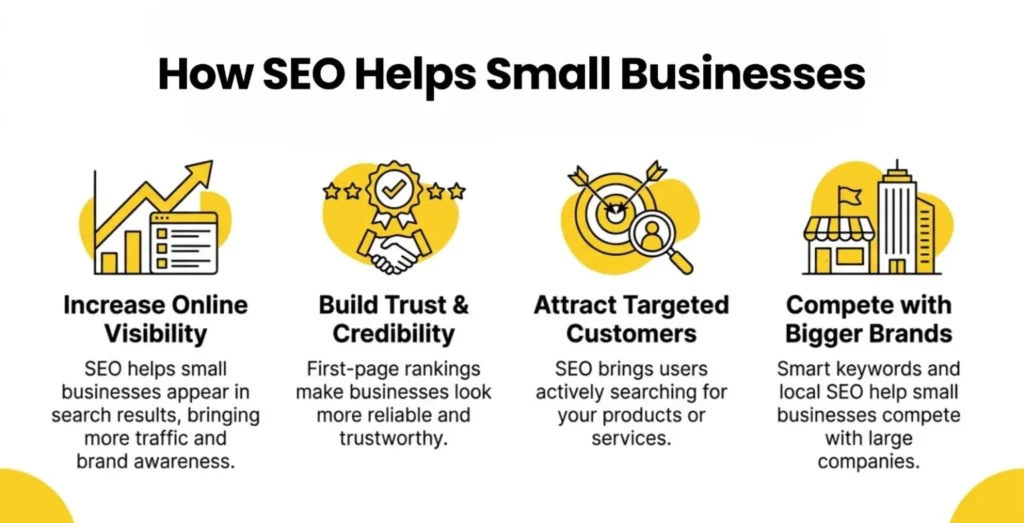
Gains Internet Presence: Small enterprises are able to be discovered by interested buyers of the products or services they offer in a digital market with the aid of SEO in a saturated market. Advanced positions in the search imply increased visibility, traffic on the site, and brand awareness without paying much attention to the paid advertising.
Develops Believability and Trust: The websites that are listed on the first page of the search results are believed to be more credible. Quality content, optimized site structure, and secure browsing are some of the SEO practices employed to build credibility and assure customers.
Fan-Focused and Economical Traffic: SEO brings in users who are in search of what your business is selling. This focused traffic leads to increased conversion rates and long-term value as opposed to short-term paid campaigns.
Helps Compete against Bigger Brands: Along with clever keyword techniques, local search engine optimization, and content optimization, small enterprises will be competitive enough to compete with bigger companies and gain a significant presence in particular markets.
How Search Engines Work?
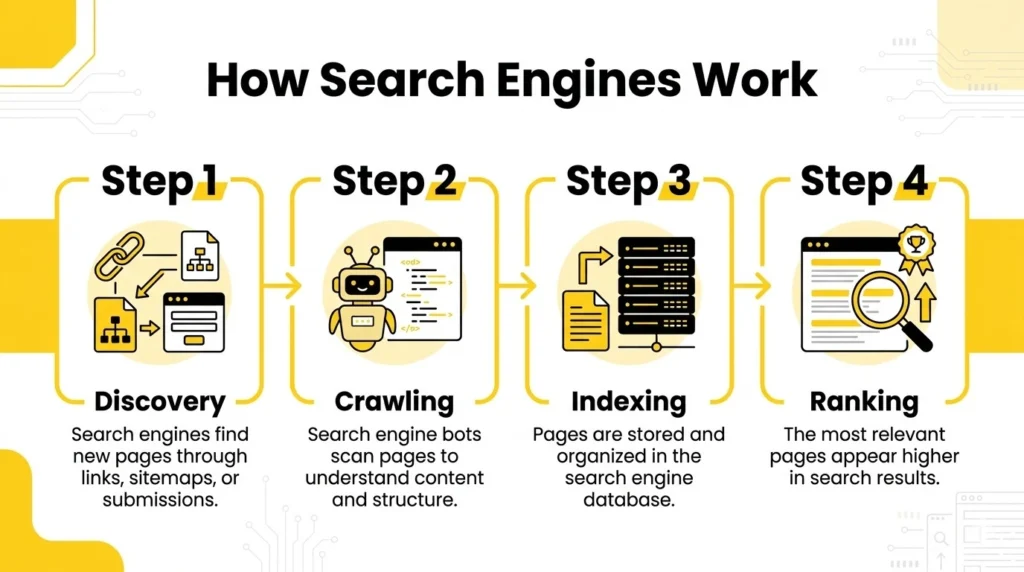
Search engines like Google follow a step-by-step process to find and display the most relevant results for users. It all begins with discovery, where search engines become aware of new or updated web pages through links, sitemaps, or directory submissions. Once a page is discovered, it moves to the crawling stage, where bots visit the page and analyze its content, structure, and technical elements.
After crawling, the page goes through indexing, where it is stored in a massive database and categorized based on its content, keywords, and relevance. Finally, during the ranking stage, the search engine evaluates all indexed pages and displays them in order of importance based on factors like quality, relevance, user experience, and authority.
Example: Suppose you run a small bakery in your city and create a website for it. First, search engines discover your website through links or submission. Then, they crawl your site to understand details like your menu, location, and services. After indexing this information, when someone searches for “best bakery near me,” the search engine ranks your website based on how relevant and optimized it is. If your SEO is strong, your bakery website can appear higher and attract more customers.
Small Business SEO vs Local SEO
| Aspect | Small Business SEO | Local SEO |
|---|---|---|
| Definition | Small Business SEO focuses on improving a website’s visibility on search engines for a broader audience, including national or niche markets. | Local SEO focuses on optimizing a business to appear in location-based searches, especially for nearby customers. |
| Target Audience | Targets a wider audience that may not be limited to a specific location. | Targets people searching for services in a specific area or city. |
| Search Intent | Includes informational, transactional, and niche-specific searches. | Primarily focuses on “near me” or location-based search queries. |
| Keyword Strategy | Uses general and industry-related keywords like “best digital marketing services” or “affordable web design.” | Uses location-based keywords like “best salon in Delhi” or “IT companies in Bhavnagar.” |
| Google Business Profile | Not always necessary for all small businesses. | Very important for visibility in local search results and Google Maps. |
| Competition Level | Competes with both small and large businesses across broader markets. | Competes mainly with businesses within the same local area. |
| SEO Techniques | Includes on-page SEO, content marketing, backlinks, and technical SEO. | Includes local citations, Google Maps optimization, reviews, and local backlinks. |
| Results Visibility | Appears in organic search results across different regions. | Appears in local pack results, Google Maps, and location-specific searches. |
| Use Case | Best for businesses offering online services, products, or targeting a wider audience. | Best for businesses with a physical location or serving a specific geographic area. |
| Examples | Online stores, SaaS companies, digital marketing agencies. | Restaurants, salons, clinics, local service providers. |
Why Both Matter
Using both Small Business SEO and Local SEO together gives the best results. For example, if you run a bakery, Local SEO helps you appear in searches like “bakery near me” or “best bakery in Delhi,” bringing in nearby customers and increasing walk-in orders. At the same time, Small Business SEO helps you reach a wider audience through content like “best cake designs” or “birthday cake ideas,” driving online traffic and building brand awareness. In simple terms, Local SEO brings immediate local customers, while Small Business SEO supports long-term growth and broader reach—using both ensures steady and sustainable business growth.
Key Elements of Small Business SEO
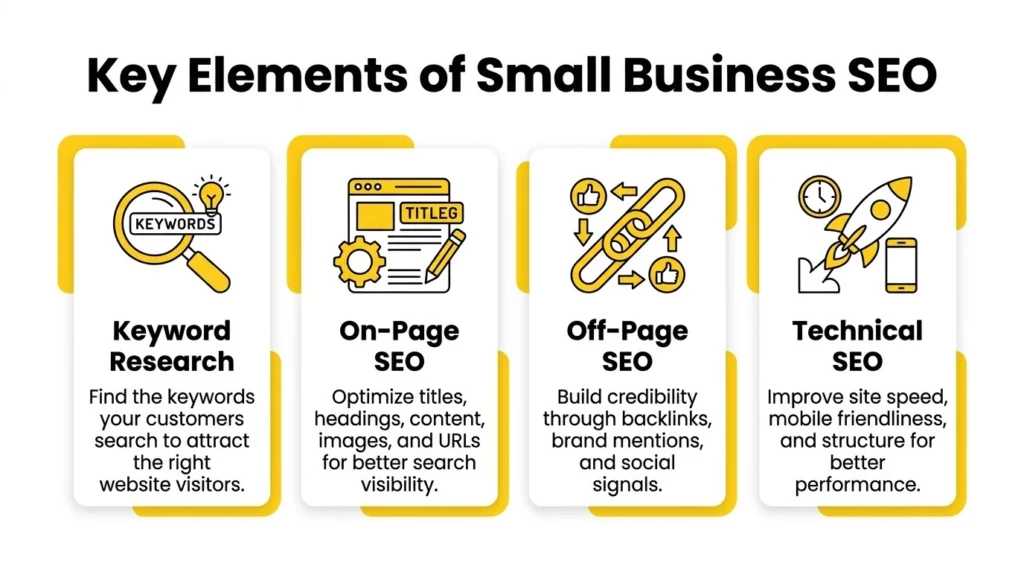
Small Business SEO relies on a few core components that help improve your website’s visibility, attract the right audience, and drive consistent organic traffic. When these elements are properly optimized, they work together to strengthen your online presence and support long-term growth.
- Keyword Research: This is where your SEO strategy begins. It involves finding the exact words and phrases your target audience is searching for on search engines. By targeting the right keywords—especially those with good search volume and low competition—you can attract highly relevant visitors who are more likely to convert.
- On-Page SEO: On-page SEO focuses on optimizing everything within your website. This includes using keywords naturally in titles, headings, meta descriptions, URLs, and content. It also involves improving readability, adding internal links, and optimizing images so both users and search engines can easily understand your pages.
- Off-Page SEO: Off-page SEO is all about building your website’s authority and trust outside your site. This mainly includes getting backlinks from reputable websites, understanding different types of backlinks, along with brand mentions and social signals. The more high-quality and relevant links you earn, the more search engines see your site as credible and rank it higher.
- Technical SEO: Technical SEO ensures your website performs well behind the scenes. It includes improving page speed, making your site mobile-friendly, fixing broken links, creating a proper site structure, and ensuring search engines can crawl and index your pages efficiently. A technically strong website provides a better user experience and supports higher rankings.
Small Business SEO: A Complete Step-by-Step Guide
1. Identify keywords in your niche
The purpose of the keyword research is to make you realize what your potential customers enter into search engines. You do not guess, but you identify actual search terms that have demand and intent. Begin with brainstorming services that you provide, and check them with the help of a keyword research service, such as Semrush.
Target keywords with a decent search volume and low keyword difficulty in order to be able to rank as a small business.
Be attentive to search intent and commercial keywords tend to be those of a user who is willing to hire or purchase. Keep adding words and similar concepts to your list, with the help of keyword suggestions.
Example:
A security agency searching for bodyguard services finds related terms such as “VIP protection services” and “executive security,” and they are able to make several high-intent searches.
2. Design Relevant Pages of Your Site
Having your keywords, make separate pages on the service rather than putting it all on one. Each page is to be devoted to one primary service and keywords that are closely related. This assists search engines in knowing better what you are selling and enhances ranking possibilities.
A clear description, benefits, testimonials, and good calls to action should be incorporated in your service pages. Maximize valuable on-page features such as title tags, meta descriptions, URLs, headings, and body content.
In case you serve more than one location, create location-specific pages to win local search and enhance relevance.
Example:
A security company sets up different pages, such as Executive Protection Services, Celebrity Bodyguard Services, and Event Security Services, each with its own keyword set.
3. Enhance the Site Organization and Navigation
A clean structure of the site will ease the searching of the content by the users and the search engines. You want to have all the important pages just a few clicks from the home page. This enhances crawling as well as indexing of your pages by search engines.
Group similar pages together logically, e.g., all services on the same main menu, called Services, and all city pages in a section called Locations. There should be no excessive navigation or page structures.
The scalable structure will enable you to add services or locations in the future without having to restructure your site.
Example:
The structure of the site is as follows: Home → Services → Executive Protection → New York City; thus, the navigation is easy and search engine-friendly.
4. Create Helpful Blog Content
The content of the blogs would assist in attracting users in various stages of the purchase process. You do not want to sell, but you want to inform, solve problems, and gain confidence. Topic research instruments can assist you in finding out what your readers want to know.
Pay attention to the development of really useful content, simple to read, and organized to use a subheading and bullet points. Be skilled and not only appear credible through sharing genuine knowledge and experience.
Quality blog content will drive organic traffic, gain authority, and create internal links to your service pages.
Example:
A security firm will publish blog articles such as How Executive Protection Works or When Do You Need Event Security to draw and inform potential customers.
5. Identify and resolve technical SEO problems
Technical SEO makes sure that the search engines are able to crawl, comprehend, and index your site in the proper way. Good content will not rank when there is a blockage caused by technical problems. Luckily, the small business websites tend to have fewer problems, and the majority of solutions are simple.
Follow up with a site audit tool to diagnose such issues as broken links, duplicate meta descriptions, missing alt text, or slow-loading pages. Target the high-priority issues initially, since they are the ones that are most visible.
Technical SEO repair will enhance user experience and allow your rankings to perform more consistently.
Example:
An audit of the site indicates the presence of broken internal links and the absence of meta descriptions. They are then repaired, and the indexing and search ranking of the site are boosted.
6. Build Backlinks
Backlinks refer to connections of other sites to your site, and they are one of the strongest ranking factors of Google. They become signs of trust because they demonstrate that other people have confidence in your business.
It is a question of quality and not quantity. Pay attention to the receipt of backlinks on reliable websites that are relevant. A study by Backlinko showed that the higher the ranking, the more backlinks the page will have.
Begin with local directories, search engine submissions, media-related actions, partnerships, and community participation.
Example:
A security company sponsors a local event where it gets a backlink on the event website, which increases authority and local rankings.
7. Design and Optimize Google Business Profile
Google Business Profiles are unavoidable in minor businesses with local customers. It makes you visible in the local map searches and instantly connects to your address and services, as well as reviews.
Enter all details in your profile, make the right categories, use good photographs, and update yourself frequently. Google records that profiles that are complete are much more inclined to generate visits and calls. In case you have several locations, then you have to create individual profiles.
Example:
The description of the services, photos, and updates of a security company maximizes its profile, and the number of phone calls in the local search results will increase.
8. Build Local NAP Citations
NAP citations are Web-based references to your business name, address, and telephone number in directories and websites. It has to be consistent; any deviation will disorient the search engines and damage local ranking.
Make sure that your information is the same across all locations, like directories, social sites, and industry sites. The tools have the ability to detect inaccurate or missing listings and correct them effectively. Consistent citation enhances credibility and boosts local search optimization indicators.
Example:
A company can fix inaccurate phone numbers in directories and experience better local search results in a few weeks.
9. Track Your SEO Progress
Measurement of performance will make you see where you are doing well and where changes are needed. Look at those metrics that directly affect an increase in business and not vanity figures.
Monitor leads, organic traffic, keyword ranking, backlink acquisition, and keyword coverage. Measure traffic, conversions, and visibility in search by using Google Analytics and Google Search Console. You should monitor regularly to evaluate your strategy and make informed decisions.
Example:
A company follows the organic leads on a monthly basis and finds out that most of the conversions are happening on service pages, and it continues to optimize the service pages.
Common SEO Mistakes Small Businesses Should Avoid
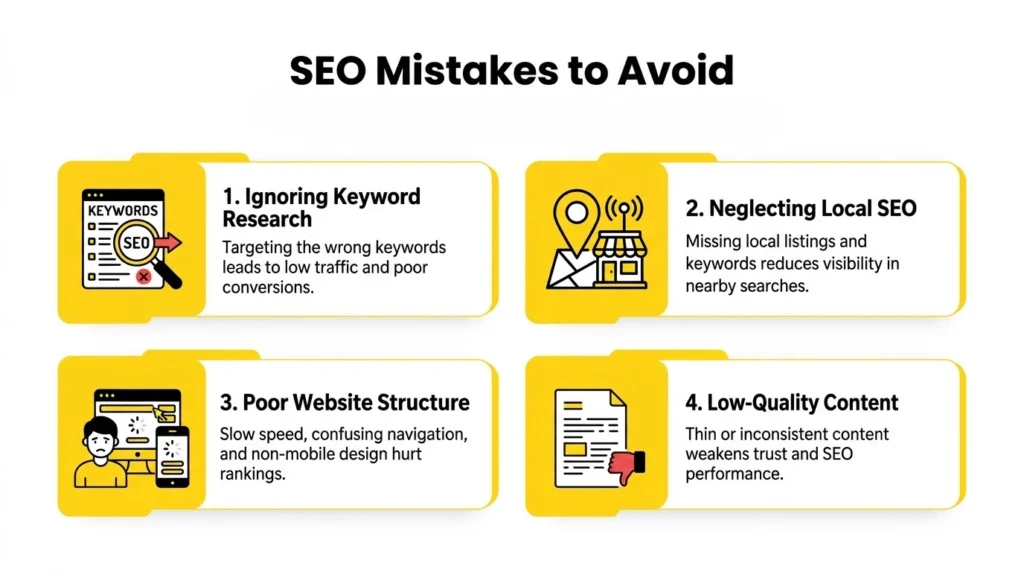
Before diving into specific mistakes, it’s important to understand that even small SEO errors can significantly impact your website’s visibility and growth. Being aware of these common issues helps you avoid them early and build a stronger, more effective SEO strategy.
- Ignoring Keyword Research: One of the biggest SEO mistakes small businesses make is skipping proper keyword research. Targeting the wrong keywords or guessing search terms can lead to low traffic and poor conversions. Always focus on keywords your customers actually search for.
- Neglecting Local SEO: Many small businesses fail to optimize for local searches. Missing or incomplete local listings, inconsistent NAP details, and a lack of local keywords can significantly reduce visibility in nearby searches.
- Poor Website Structure and User Experience: A confusing site structure, slow page speed, and non-mobile-friendly design hurt both user experience and search rankings. Search engines prioritize sites that are easy to navigate and load quickly.
- Publishing Low-Quality or Inconsistent Content: Thin, copied, or irregular content weakens trust and authority. Consistent, helpful content is essential for long-term SEO success and sustainable business growth.
How AI is Changing SEO: AEO vs GEO vs AIO
As search engines become more AI-driven, the way content is discovered and presented is rapidly changing. It’s no longer just about ranking on search result pages—now it’s about being the best answer, being trusted by AI systems, and being easily understood by algorithms. This is where AEO, GEO, and AIO come into play.
AEO (Answer Engine Optimization)
AEO is all about structuring your content in a way that directly answers user questions. Search engines and voice assistants now prioritize quick, clear, and accurate responses. To optimize for AEO, your content should include concise definitions, FAQs, bullet points, and well-formatted headings. The goal is to appear in featured snippets, voice search results, and instant answers, where users don’t even need to click a link to get information.
GEO (Generative Engine Optimization)
GEO focuses on making your content valuable for AI tools that generate answers, such as chatbots and AI search engines. Instead of just ranking on Google, your content should be detailed, trustworthy, and context-rich so AI can reference or summarize it when generating responses. This means using clear explanations, covering topics in-depth, and building authority so AI systems consider your content reliable enough to include in their outputs.
AIO (AI Optimization)
AIO is about optimizing your content specifically for how AI systems read and understand information. It involves using proper structure, semantic clarity, and context so algorithms can interpret your content correctly. This includes writing in a natural, human-like tone, using related keywords (not just exact matches), and organizing content logically. The goal is to make your content easy for AI to process, connect with user intent, and present in different formats like summaries, recommendations, or search results.
Example: Imagine you run a digital marketing blog. With AEO, you provide clear, direct answers like “What is SEO?” in a simple format. With GEO, your in-depth article becomes a trusted source that AI tools use while generating answers. With AIO, your content is well-structured and context-rich, making it easier for AI systems to understand and showcase it across different platforms.
Ending Note
SEO is a long-term investment in the success of your brand. Although the outcome is not immediate, the ongoing optimization will be rewarded with long-term returns that increase over time. With the search intent, local visibility, technical health, and valuable content, small businesses are able to build trust with the search engines and the consumers.
The trick is to remain patient, evidence-based, and flexible, as the algorithms and user behavior will change. Whether you are new or improving your current strategy, SEO helps your business compete, grow, and remain visible in the noisy digital arena. Begin small, remain steady, and allow the process of SEO to become a massive business growth engine.
FAQs
1. What is The Advantage of AI in SEO to Small Businesses?
With the assistance of AI, small businesses can save time, minimize costs, and make data-driven decisions in SEO optimization because it automates keyword research, content optimization, and performance monitoring.
2. Are Small Businesses Unable to Afford AI-based SEO?
Not necessarily. Numerous low-cost AI SEO software are in place that provide the necessary functionality and advanced SEO to small businesses with small marketing budgets.
3. Is It Possible to Substitute Human SEOs with AI?
AI is useful in SEO activities, but cannot completely displace human skills. The strategic planning, creativity, and knowledge of brand voice still need a human touch to achieve good results in SEO.
4. Does AI Enhance The Quality of Content to Optimize Search Engines?
Yes, AI is used to optimize content structure, readability, and placement of keywords so that the content is relevant to the search intent and enhances visibility without it being subject to quality.
5. Will AI Alter The Ranking of The Search Engines?
AI algorithms are already being used by search engines. Companies that apply the methods of AI-based SEO are more likely to adjust to changes in rankings and comply with the shifting expectations of search engines.