
Did you know that websites with good backlinks tend to rank higher on Google compared to those without them? Actually, search engines have recognised backlinks as one of the three most important ranking factors in determining which pages should be ranked first. It is called link building, where other websites gain backlinks for you. It helps search engines identify your site as reliable, worthy, and important to users.
These connections serve as online suggestions — every one of them warrants that your content is worth visiting. Not every backlink is the same. Quality links are those that come through the authority of relevant sites and enhance your SEO, while bad or spammy links can actually worsen rankings. There are different types of backlinks, each carrying its own value and impact on your website’s performance. Regardless of the competitive digital environment nowadays, link building remains the key to enhancing visibility, organic traffic, and long-term credibility of your site. In this blog, we will learn about link building, the types of backlinks, and how it works.
How Backlinks Work and How to Get Them?
Backlinks are links from other websites that point to your own pages. Search engines, such like Google, consider these links as indications that your domain or content is trustworthy and useful. When credible and relevant sites link to you, it helps build your credibility and can improve your visibility in search results.
While the amount of backlinks is important, quality outweighs quantity. A few powerful connections from reputable websites are significantly more beneficial than dozens of low-quality ones. Earning these high-value backlinks requires consistency, quality content, and deliberate marketing.
1. Creating Basic Connections between Social Profiles and Business Listings
Begin by building profiles on the leading platforms such as Google Business Profile, Facebook, Instagram, and LinkedIn. Include your website in the profile bio or contact. These are simple backlinks that are trusted which are a boost to your brand. Then, post your business to directories like Justdial, IndiaMART, Sulekha and Yelp India. Make sure that your business name, address, and contacts are the same on every platform. This increases trust and visibility of search.
2. Requesting Links via Smart Outreach
Contact bloggers, business collaborators or influencers within your niche. Request them in a polite way to mention or refer to your website in case you have the related content. You may post as a guest, create a useful post in their blog or swap case studies. As an example, a restaurant may partner with a food blogger to review its services with a backlink. Your outreach messages should always be authentic and personal to create actual relationships.
3. Paid Links and Their Danger
Buying backlinks can be considered a type of shortcut, but it is risky. Spammy or irrelevant paid links are against the rules of Google and may lead to a penalty. Rather than spending money, pay attention to the ethical practices of link-building, such as content creation, -citations, and outreach. Google is a company that embraces authenticity organic backlinks are always more lasting and they are more effective in providing SEO services.
4. Linking through Merit with Valuable Assets
Natural backlinks are the most effective as they occur when other people find your content useful. Produce informative blogs, instructions, infographics, videos or free utilities that the reader can use.
As an example, in this case, if you have a salon, you write a “Top 10 Hair Care Tips to Winter guide”, which websites might also be interested in referring to. You must share your content on social media to get attention and motivate sharing. The more practical your content, the more backlinks your content will get in the long run.
What Are the Benefits of Link Building?
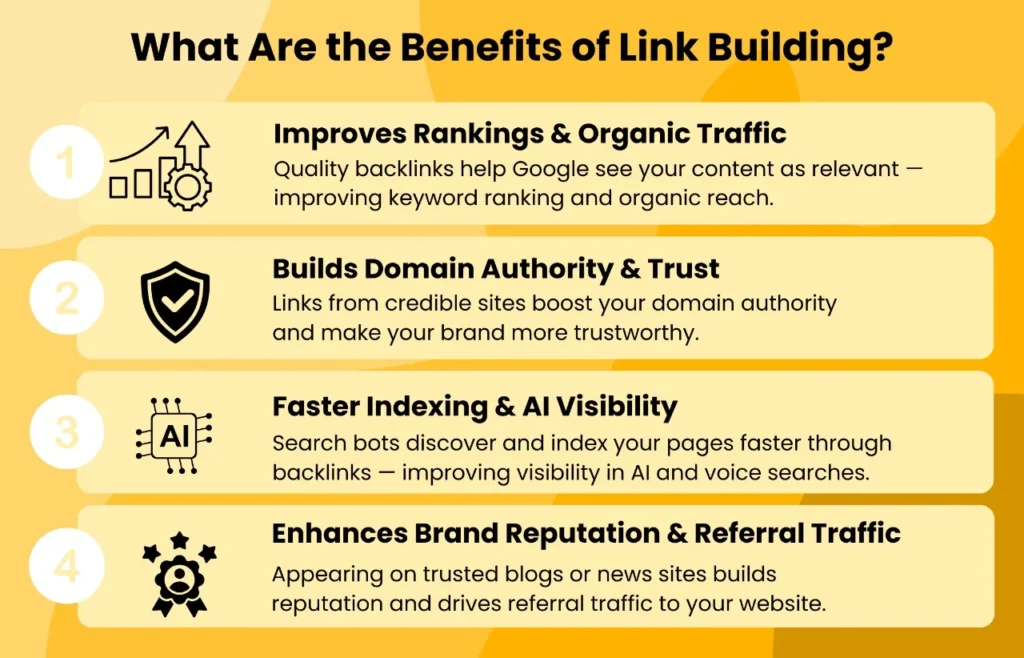
It not only helps attract customers, but also gains credibility in your community. The advantages of link building to your site are as follows:
1. Improves Rankings and Organic Traffic.
Good quality backlinks with related sites will make search engines know the relevance of your content. Google gives your keywords preference when trusted sites refer to your pages. This enhances organic traffic, the users who are seeking products or services that are within their area. A backlink to a blog or directory, an example, will channel specific visitors to your business site.
2. Gains Domain Authority and Website Trust.
Backlinks are perceived as other sites in good faith. The better the links you get on authoritative sites the more your domain authority will be. The increase in domain authority indicates to search engines that your site is trustworthy and enhances your potential to be ranked higher and that the users of your site have better trust in your brand.
3. Allows Indexing More Quickly and Visibility in Search Results in AI.
Bots used on search engines find new pages through backlinks. With numerous quality links on your site, it is faster to crawl and index. In addition, with the development of AI-driven search engines, they are starting to favour trusted and well-connected websites, which in turn allows your business to be displayed more often in the AI-generated search results and voice search results.
4. Improves Brand Reputation and Referral Traffic
Getting backlinks on popular blogs, news websites, or other directories creates your brand authority. It makes your business a guru in your industry. And, when your users use them to follow the backlinks, they get to your site, referring traffic that can turn into actual customers.
What Determines the Quality of a Backlink?
Below are the key aspects to consider to have a good backlink:
- Relevance of Content and Linking Site: The websites that are associated with your niche or topic will be more valuable and will be trusted by the search engine.
- Domain Authority and Credibility: High-quality and reputable sites are considered to be the strongest sources of backlinks that have greater SEO power than low-quality and spammy sites.
- Positioning of links in the text: The links that are made naturally in the body of an article carry more weight than the links located in the footers, sidebars or the bio of the authors.
- Value of Traffic of Linked Website: The backlink of a site with high organic traffic will result in real traffic visiting your page and enhance visibility and interaction.
- Natural Velocity of the links, or Risk Signals: Earning the backlinks in the long run is natural to Google and the number of links obtained too quickly might be considered as manipulative and cause penalties.
What Are the Best Link Building Strategies?
Effective link building must be achieved through an intelligent combination of content, relationships and authority. The best link-building tactics that are expounded simply, to suit SEO oriented audiences and local audiences are given below:
A. Content-Based Link Building
The best method of acquiring quality backlinks is through content.
- Guest Post: Write helpful, informative articles for reputable websites in your niche, especially those listed as instant approval guest post —and include a natural, relevant link back to your own site within the content.
- Skyscraper Technique: Identify the best content people are doing in your industry, then do it to an even better level, and contact the we bsites where the former content is found to swap links to yours.
- Expert Roundups: To work with industry experts, round up their opinions on a post, and they will frequently share and refer to it.
- Digital PR and Newsworthy Content: Post original content, release news or local success that can be covered by the news websites and blogs.
- Data-Based Resources, Surveys, and Infographics: Develop research-supported materials or graphics that other people will desire to cite and refer to.
B. Relationship Building Link Building.
It is necessary to establish actual relationships to achieve natural backlinks over time.
- Blogger Outreach: Partner with bloggers or influencers within your niche to collaborate, review or feature with a backlink.
- Partnerships and Collaborations: Find a local business or brand that you can team up with to promote or launch a campaign where both sides have links to websites.
- HARO (Help a Reporter Out) Responses: Answer questions of journalists with professional knowledge- When used, your site will be mentioned and cited in the source of authority news websites.
C. Authority and Trust Building
The strategies will assist in enhancing the credibility and searchability of your brand.
- Brand Mentions and Citations: You must have your business name and web address listed in reputable forums, directories and review sites.
- Thought leadership content and Webinars Share authority or organise education that will be noticed and linked to by professional circles.
- Podcasts and Niche Communities: Feature on the podcasts or join the online discussions to receive the natural backlinks and gain trust within a niche.
D. Passive Link Acquisition
- Automatically gain backlinks based on resources of value that are long-term.
- Evergreen Resources (Tools or Calculators): Make useful tools such as ROI calculators, checklists or templates that other people look at and refer to often.
- Free Templates (Free Downloads): Provide free eBooks, guides or templates- this will receive a backlink to a site that will recommend useful resources.
Other Submission Sites
What Link Building Practices Should Be Avoided?
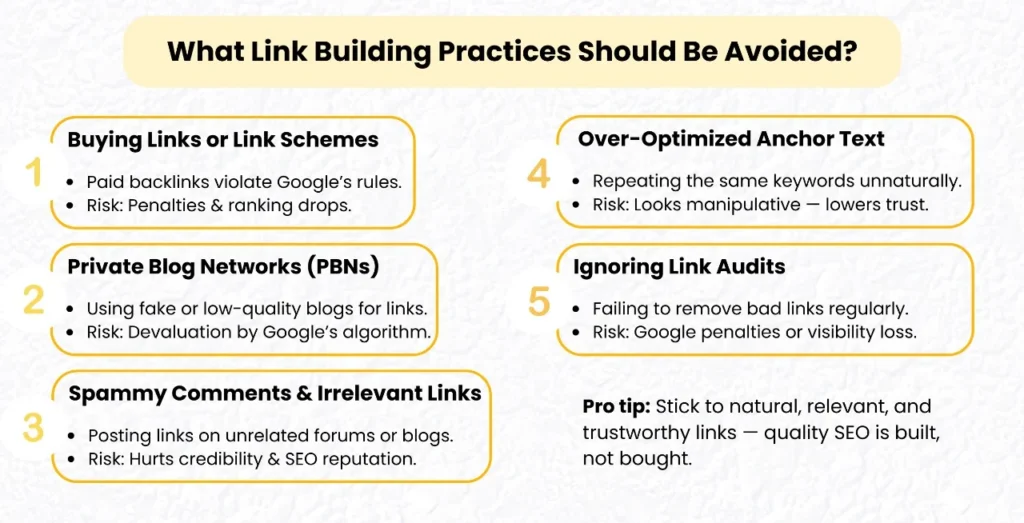
Not every backlink is SEO friendly. Others may even destroy your rankings or inflict Google punishments. The following are the link-building errors that any SEO expert should never commit:
- Buying Links or Link Schemes: Backlink purchases are against the rules of Google, which can cause sanctions or loss of positions.
- Private Blog Networks (PBNs): It is not advisable to use networks of fake or poor-quality blogs to establish links, and Google can see them and devalue them easily.
- Spam Messages and Irrelevant Forum Links: Placing links on irrelevant blog comments or forums appears to be unbecoming and can damage your credibility.
- Over-Optimised Anchor Text: Redundancy of repetition of the same keywords in the backlinks also feels contrived- include natural and different phrases.
- Google Fines and Prevention Approaches: You should never take shortcuts, you should create organic links and you should do a regular check on your backlinks by eliminating any harmful or spammy links.
How to Track and Measure Link Building Success?
The most important SEO metrics to track to determine whether your link-building activities are effective or not are:
- Backlink Growth Metrics: Monitor an increase in new backlinks over a period of time by using such tools as Ahrefs or SEMrush.
- Traffic Enhancements Organic: Determine whether your organic traffic is on the rise following the creation of quality backlinks on your website.
- Keyword Ranking Progress: Keep track of the progress of your target keywords in the Google search engine as the build of backlinks builds authority.
- Connection Quality and Referral Traffic Analysis: Determine the relevance and the traffic of your backlinks and the number of visitors they generate.
- Market Share and Visibility vs. Competitors: Just as you compare your backlink profile and domain authority with your competitors to assess your SEO development and visibility.
How Does Link Building Support SEO?
An important role of link building is to increase your local and organic SEO performance through increased visibility, authority, and trust. The way it helps your SEO efforts is the following:
- In-Sourcing and Directory Submissions: Being featured on reputable, reliable business directories such as Justdial, IndiaMART or Yelp produces consistent backlinks, which enhance local business search and boost your ranking on Google.
- Recommendations for Google Business Profile Enhancement: Your link to the website and frequent updates to your Google Business Profile give your web presence in the area, credibility, and more opportunities to be listed in the local search and Google Maps.
- PR and Participation in Events: The exposure through press release, news or community events also gives you potent backlinks with high authority sources- increasing your online visibility and brand credibility.
What Is the Link Building Checklist?
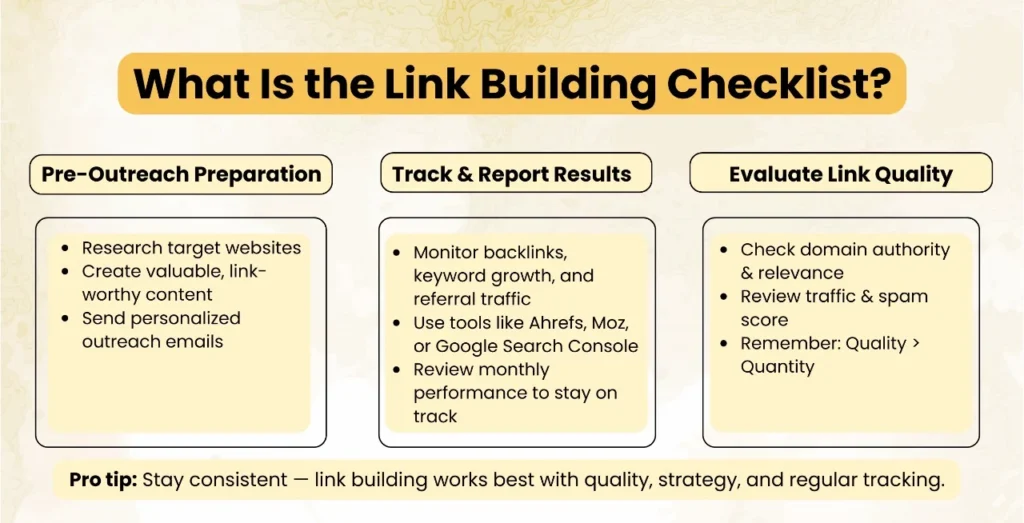
It is a good checklist on link building that enables you to remain organised, ensure quality and keep track of the outcomes. Here’s what to include:
- Pre-Outreach Preparation: The strategy involves contacting site owners to get backlinks with research target websites, creating valuable content and tailoring personal outreach emails.
- Quality Evaluation Criteria of the Links: The domain authority, relevance, traffic and spam score of the site should always be checked before securing a link; quality is more important than quantity.
- Tracking and Reporting: Each month, the company executes an overall plan of innovative products and services and advances the innovations.
- Track your backlinks, rise in keyword ranking and referral traffic monthly through such tools as Ahrefs, Moz, or Google search console.
Conclusion
Link building is considered to be among the strongest tools of SEO as it allows websites to become more visible, credible, and ranked higher in search engines. It has the power to be a trust-building tool, the one that links your site to another source of authority and sends Google a message that your information is worthy. Link building is a long-term and sustainable source of growth in SEO.
When properly done, it will provide you with constant organic traffic, a better position in the search results and overall authority of your domain. Instead of getting quick or paid links, concentrate on getting the quality back links. To be successful in the future, make money investing in content-based, relationship-based, and ethical link acquisition. The keys to creating a strong backlink profile that is here to stay are consistency, authenticity and patience.
FAQs
1. What is Link Building in SEO?
Link building refers to the activity of having other websites to link to your sites to increase your authority and search results.
2. What is the Number of Backlinks that are Needed to Rank?
No specific figure- it depends on your rivalry, the intensity of the key word and the quality of the links.
3. What is the Time it Takes Link Building to Start Bearing Fruits?
Generally, 3-6 months are required to experience tangible improvements in rankings as a result of the regular link-building activity.
4. Are Nofollow Links Useful?
Yes, nofollow links can be good, because they assist in traffic, brand visibility/building, and they can diversify backlink profiles.
5. Is there any Infrastructure About the Negative Effects of Link Building on SEO?
Yes, the spammy, paid, or irrelevant backlinks may result in the Google punishment and negatively affect your positions in the search results.