
Online ordering stopped being a side channel years ago. For a lot of restaurants, it now outpaces the dining room, which means the system handling it is no longer a bolt-on. It is the thing your revenue runs through.
The hard part was never taking the order. It is keeping one menu true across your website, your POS system for restaurants, and four delivery apps at the same time. It is what happens to the kitchen when tickets land from three platforms at once. And it is watching processing fees take a bite out of margins that were already thin. After reviewing dozens of platforms built for food and beverage operations, this guide covers the five worth your attention.
How This Ranking Was Put Together
Platforms were evaluated using publicly available information: review sites, case study libraries, feature breakdowns, and official product pages. The shortlist only kept platforms with a real, proven footprint in food and beverage. Nothing made the cut without demonstrated results in a restaurant or hospitality context.
→ See the full research breakdown
- Orders.co — Best for running every order channel from one screen
- Square — Best for small to mid-size food and beverage businesses
- GoTab — Best for mid to large venues, breweries, bars, and hospitality
- Lavu — Best for multi-location food and beverage operators
- Clover — Best for restaurants that want an open app marketplace
Why Online Ordering POS Systems Are Worth a Closer Look
Picking the wrong system does more than slow you down. It shows up as wrong prices on DoorDash while your POS has the right ones, orders arriving on a tablet nobody is watching, and duplicate tickets printing in the middle of a Friday rush.
The right system removes those problems at the source. Platforms built for food and beverage bring menu sync, multi-platform order routing, and payment processing designed around how a kitchen works rather than how a retail counter works.
That shows up in the numbers. A system that fits your operation tends to lift average order value, cut order errors, and raise daily online volume without adding work for anyone. It is a rarer combination than the marketing suggests.
Comparing the 5 Best Online Ordering POS Systems
All data in this table comes from review platforms and the official websites of the listed companies.
| Company | Years Operating | Team Size | Headquartered In |
| Orders.co | Est. 2020 | – | Los Angeles, CA |
| Square | Est. 2009 | 6,645 | San Francisco, CA |
| GoTab | Est. 2015 | 76 | Arlington, VA |
| Lavu | Est. 2010 | 202 | Albuquerque, NM |
| Clover | Est. 2010 | 1,507 | Sunnyvale, CA |
List of Best POS System for Restaurants
1. Orders.co — Best for running every order channel from one screen
How Is Orders.co Defined in Its Industry?
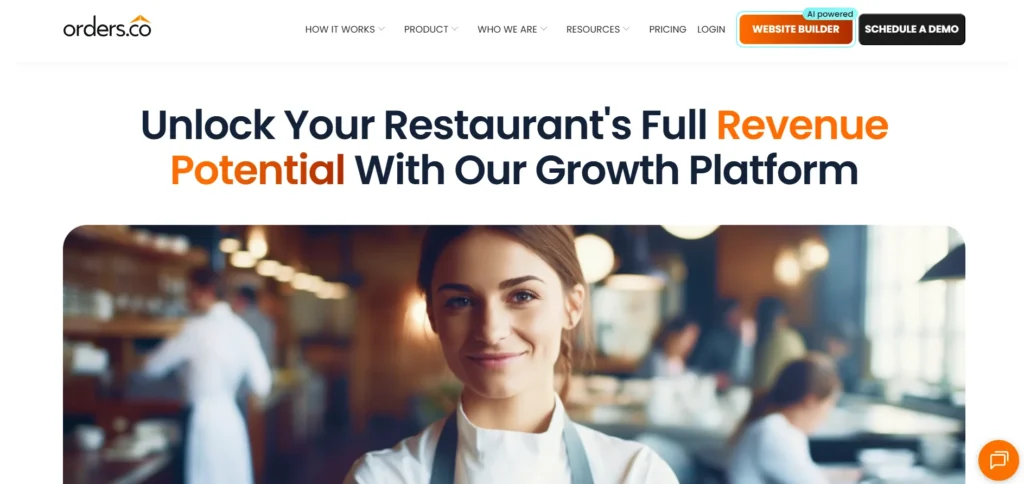
Orders.co is a restaurant POS system built specifically for restaurant workflows, which separates it from general-purpose platforms designed to serve every kind of merchant. It runs the counter, taking orders and processing payments, and keeps your menu and inventory in the same place. Every order channel feeds into one queue, and the reporting covers the whole picture, from daily sales to which delivery provider is actually earning its cut.
Loyalty and marketing come with it rather than as separate subscriptions. It is a cloud-based solution, so menu changes sync across every platform in seconds and you can check sales from any device without being at the restaurant. You can run it on a full countertop station with a built-in ticket printer, or on just a tablet and card reader if space is tight.
Why Does Orders.co Stand Out for Online Ordering POS System?
Most platforms treat online ordering as an added feature. Orders.co connects it to the POS itself, which is why the menu, delivery, marketing, and loyalty all work off the same data. Orders from DoorDash, Uber Eats, Grubhub, ezCater, and your own site arrive in one dashboard, and any menu change you make pushes to all of them at once. Because it was built for restaurants, it handles what generic systems struggle with: nested modifiers, half-and-half builds, and topping prices that change by size.
Two things are uncommon at this tier. Delivery dispatch is AI-assisted, so when no in-house driver is free the system picks the most cost-efficient third-party driver by cost and availability, with no separate contract to sign. And chargebacks from third-party apps get disputed inside the POS rather than across four portals, with 90% resolved in the restaurant’s favor. For operators losing 20–30% to delivery apps, the commission-free branded ordering site connects straight to the POS and keeps both the margin and the customer data, with restaurants averaging a 54% lift in direct orders.
What Users Are Actually Saying:
Operators most often mention running every ordering platform without a counter full of tablets. Real-time menu syncing comes up regularly, along with the automated SMS and email marketing and the loyalty tools. The freedom to switch between your own drivers and third-party dispatch as a shift demands gets noted too, as does handling delivery disputes without logging into a separate system for each app.
2. Square — Best for Small to Mid-Size Food and Beverage Businesses
How Is Square Defined in Its Industry?
Square built its reputation on the first mobile card reader and has not slowed down since. It is now the U.S. market leader in point of sale, serving 4 million sellers who process $241 billion in payments a year. For food and beverage, its value is running bookings, inventory, customer communication, and payments from one connected system, which is rare at the price points it offers.
Why Does Square Stand Out for Online Ordering POS System?
Square’s online ordering sits inside the same system that handles inventory and customers, so menu changes push across channels without separate logins or manual updates. The $0 chargeback fee is a real differentiator in a high-dispute environment where those costs add up faster than most operators expect.
What Users Are Actually Saying:
Food and beverage operators respond most to how much Square simplifies daily management. One customer reported tripling their business after switching, which is not a small claim, though Square has the 2012 Starbucks investment behind its credibility. The free entry point wins over small operators who are wary of committing to monthly fees before they know their online volume.
3. GoTab — Best for Mid to Large Restaurants, Breweries, Bars, and Hospitality Venues
How Is GoTab Defined in Its Industry?
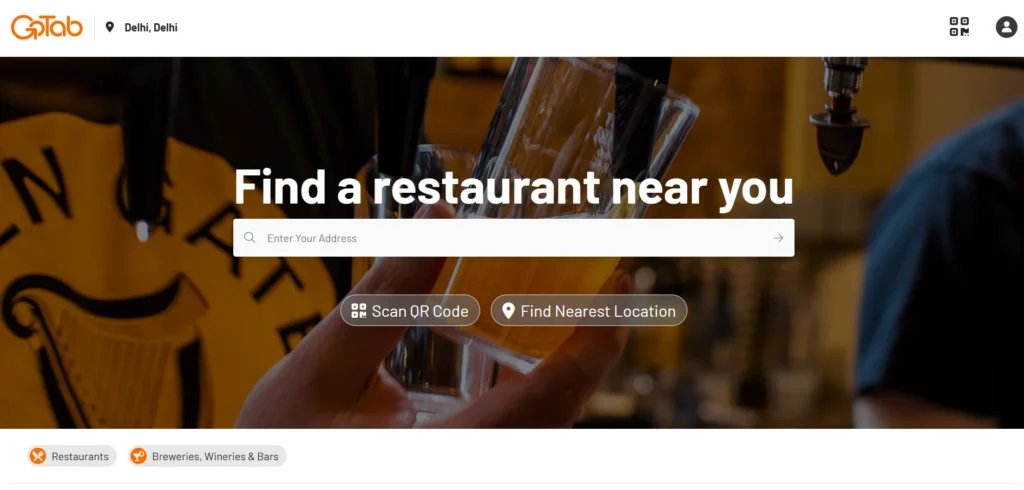
GoTab is a Restaurant Commerce Platform for mid and large venues: breweries, bars, hotels, and full-service restaurants that need more than a standard terminal. It combines mobile point of sale, contactless QR ordering, and an integrated kitchen management system, all running on any internet-connected device. That hardware flexibility matters for venues that do not want to replace what they already own. GoTab processes over $250 million in annual transactions across 35 U.S. states and Canada.
Why Does GoTab Stand Out for Online Ordering POS System?
QR ordering wired directly into kitchen management means an order moves from guest to kitchen without a server touching a ticket. That cuts errors and speeds up fulfillment when a venue is full. GoTab also prices per transaction rather than per month, which ties its revenue to your volume instead of charging the same regardless of how the quarter went.
What Users Are Actually Saying:
GoTab has earned trust from Stone Brewing Co., Barcelona Wine Bar, and Topgolf, which is a useful proof-of-concept list for any brewery or large venue. The 2021 Excellence in Customer Service Award from the Business Intelligence Group adds credibility beyond marketing claims. Operators consistently note how well it holds up in complex, high-volume service where a standard POS would strain.
4. Lavu — Best for Multi-Location Food and Beverage Operators
How Is Lavu Defined in Its Industry?
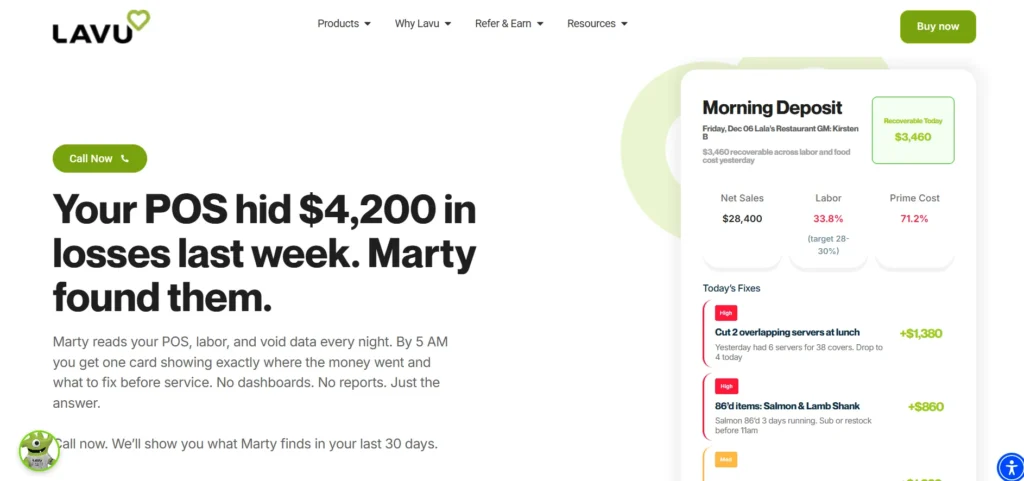
Lavu became the world’s largest mobile POS for restaurants by putting an iPad-based system in front of operators back in 2010, before anyone else did. It has processed over a billion orders across more than 80 countries. What makes it worth a look now is Marty, an AI layer that pulls POS data, payments, labor, inventory, and reporting into one view and delivers daily financial insight before service starts. Pricing begins at $59 a month and includes free hardware.
Why Does Lavu Stand Out for Online Ordering POS System?
Connecting online ordering to the Marty layer gives operators real-time visibility into how off-premise orders affect labor, inventory, and daily revenue in one place instead of across disconnected tools. For multi-location operators tracking order volume and fulfillment time across several kitchens, that single data picture is hard to match.
What Users Are Actually Saying:
Multiple G2 awards in 2025, based on verified reviews, suggest Lavu’s reputation is not built on marketing copy. Operators moving off older legacy systems tend to highlight the iPad mobility, the insight drawn from transaction data, and the integrated loyalty program. A billion processed orders lends real weight to claims about reliability at peak.
5. Clover — Best for Restaurants That Want an Open App Marketplace
How Is Clover Defined in Its Industry?
Clover is an Android POS platform processing over 2 billion transactions a year for hundreds of thousands of merchants. For food and beverage it offers two restaurant plans: Counter Service at $54.95 a month and Table Service at $84.95. Both include payment processing, inventory tracking, and staff management built around restaurant workflows. The Android foundation keeps hardware costs down, and an open App Marketplace lets third-party developers build ordering and delivery integrations on top.
Why Does Clover Stand Out for Online Ordering POS System?
The marketplace approach means Clover connects to a wide range of ordering and delivery tools without locking you into one provider, which matters if you are already committed to specific delivery partnerships. The split pricing tiers also mean you pay for the service model you actually run rather than a single subscription built for everyone.
What Users Are Actually Saying:
Clover took the gold medal for Best POS at the PYMNTS.com Innovator Awards and was named Commerce Platform of the Year in the FinTech Breakthrough Awards, both genuine third-party signals. Operators respond well to the hardware flexibility and the breadth of integrations in the App Marketplace. Magic Monkey winning an Essex Life Food and Drink Award for Best Atmosphere after deploying Clover is a nice case study, if an anecdotal one.
Methodology Behind These Picks
Gathering Baseline Data
Research started with a broad list pulled from several directions: industry directories, app review databases, hospitality trade publications, and product listing pages. Every platform had to appear across at least two independent sources before it went any further. The goal at this stage was breadth, capturing what operators actually encounter when they search, not just the platforms with the biggest marketing budgets.
The Shortlist Cut
Platforms without verifiable activity in food and beverage came off the list. Verification meant confirmed reviews from restaurant operators, documented case studies from hospitality clients, or feature pages addressing restaurant-specific workflows. Platforms with thin or inconsistent review patterns across sources were filtered out here too, leaving only options with enough real-world evidence to compare fairly.
Fact-Checking the Picks
Every published claim was cross-referenced against what users actually reported. When a company claimed a capability such as real-time menu sync or kitchen management integration, that claim was checked against verified reviews and case study documentation. Where the claims and the user reports diverged, the gap was weighed carefully. Nothing made the final list on marketing copy alone.
Authority Signals and Industry Standing
Industry recognition counted, but only as support. Awards from credible third-party organizations, mentions in hospitality trade publications, and documented partnerships with known restaurant brands were all noted. Companies with a stronger external footprint also tended to show more consistent results across review platforms, which reinforced those signals rather than letting them carry the weight alone.
Online Ordering POS System Track Record
The final check looked for evidence of real performance in online ordering specifically: dedicated product pages addressing restaurant ordering workflows, verified reviews mentioning order accuracy or fulfillment time or multi-platform management, and case studies documenting measurable results. A demonstrated track record here counted for more than a strong general POS reputation with little online ordering depth behind it.
Picking the Right Online Ordering POS System for You
The right platform depends on where your operation is now, not where you hope it will be in two years. A single-location café and a multi-unit brewery chain are not solving the same problem. These are the factors worth weighing.
- Industry experience. Look for documented history serving restaurants and hospitality. A system built around retail workflows will fight you in a kitchen.
- Features and service. Prioritize platforms that connect online ordering directly to the POS, inventory, and kitchen in one flow. Disconnected tools are what create the ticket chaos and menu drift you are trying to escape.
- Pricing structure. Compare total cost of ownership, not the monthly subscription. Factor in processing rates, hardware, and any per-transaction fees, which compound quickly once online volume climbs.
- Results measurement. A good platform shows you average order value, order error rate, and repeat customer rate. Weak reporting means no way to know whether the system is improving anything.
- Compliance. Confirm the platform handles PCI DSS and food safety data requirements, supports alcohol sales restrictions and age verification where relevant, and keeps current with local tax rules.
The Verdict
Choosing an online ordering POS comes down to fit, not feature counts. Square works for smaller operators who need an accessible starting point. GoTab suits high-volume venues with complex service. Lavu brings depth for multi-location operators.
Clover offers flexibility through its open marketplace. Orders.co is the pick for restaurants that want every order channel, their delivery, and their customer data running through one restaurant-built system. As off-premise dining keeps growing, the right system stops being optional and starts being the floor you build on.