
Most medical practices treat paid ads and organic search as separate budgets with separate goals. This guide shows you exactly how to merge them into one high-performing patient acquisition system, with less waste and more bookings.
How Google Ads and SEO Work Together to Grow a Doctor's Practice
The most effective Google Ads for Doctors SEO Outline doesn’t treat paid search and organic search as competing line items. It treats them as a single, reinforcing system where data flows freely between both channels, and each one makes the other measurably better.
Here’s how that integration works in practice:
1. Paid Ads Generate Immediate Visibility — And Real Data
Google Ads gets your practice in front of high-intent patients instantly, while simultaneously generating keyword performance data, search terms, click-through rates, conversion patterns that would take months to gather through SEO alone. This data becomes the foundation of your organic content strategy.
2. Shared Landing Pages Improve Both Channels
When the same well-structured, patient-focused landing page serves both your ad traffic and organic visitors, everything improves. SEO signals strengthen (lower bounce rates, longer session time), while Google Ads Quality Score rises — directly reducing your cost per click.
3. Appearing in Both Results Builds Patient Trust
When a patient searches “best cardiologist in [city]” and sees your practice in the paid ad slot and the top organic result, credibility multiplies. Studies consistently show that dual presence significantly increases click-through rates compared to a single listing alone.
💡 Pro Insight
| What You Gain | Google Ads Alone | SEO Alone | Combined |
|---|---|---|---|
| Immediate patient traffic | ✓ Yes | ✗ Slow (4–9 months) | ✓ Immediate + growing |
| Long-term compounding growth | ✗ Stops when budget does | ✓ Yes | ✓ Best of both |
| Keyword data & insights | ✓ Fast | ✗ Slow | ✓ Ads inform SEO |
| Patient trust & credibility | Moderate | High | ✓ Highest — dual presence |
| Cost efficiency over time | ✗ Fixed or rising | ✓ Decreasing CPL | ✓ Ads spend drops as SEO ranks |
Proven Keyword Research Techniques for Doctors in Competitive Markets
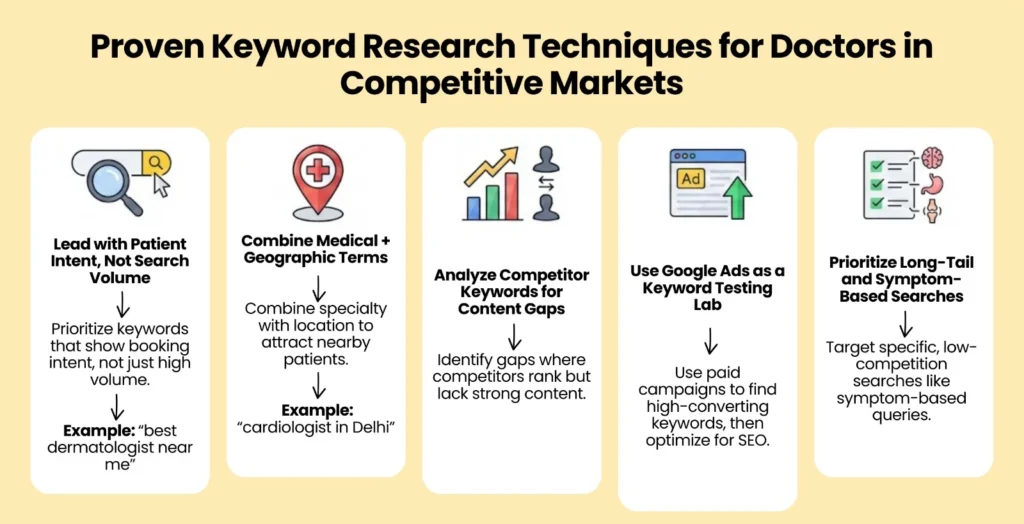
The keyword strategy within a Google Ads for Doctors SEO Outline is not about finding the highest-volume search terms it’s about finding the terms that bring in patients who are ready to book. Here’s how to do that systematically.
1. Lead with Patient Intent, Not Search Volume
A term like “knee pain treatment specialist” has far more appointment potential than “knee pain” — even if it gets fewer searches. Target keywords that signal urgency, intent to act, or a specific condition the patient wants addressed.
2. Combine Medical + Geographic Terms
Local keyword targeting reduces competition and improves conversion quality. Instead of “cardiologist,” target “cardiologist in [city/neighbourhood].” Patients looking for care near them are far more likely to convert than general information seekers.
3. Analyze Competitor Keywords for Content Gaps
Examine what your top local competitors rank for then identify topics where their content is thin or outdated. These gaps represent your fastest path to organic rankings, because the keyword demand already exists but isn’t well served.
4. Use Google Ads as a Keyword Testing Lab
Before investing in months of SEO content, run small-budget ad campaigns to test keyword conversion rates. When a paid keyword consistently drives appointment bookings, it becomes a top priority for organic ranking with the guesswork already eliminated.
5. Prioritize Long-Tail and Symptom-Based Searches
Patients often search the way they think, not the way doctors speak. Phrases like “sudden chest tightness after exercise” or “child keeps getting ear infections” have lower competition and connect with patients actively experiencing a symptom the highest-value traffic for any medical practice.
⚠️Avoid This Common Mistake
What Role Does Local SEO Play in a Google Ads for Doctors Strategy?
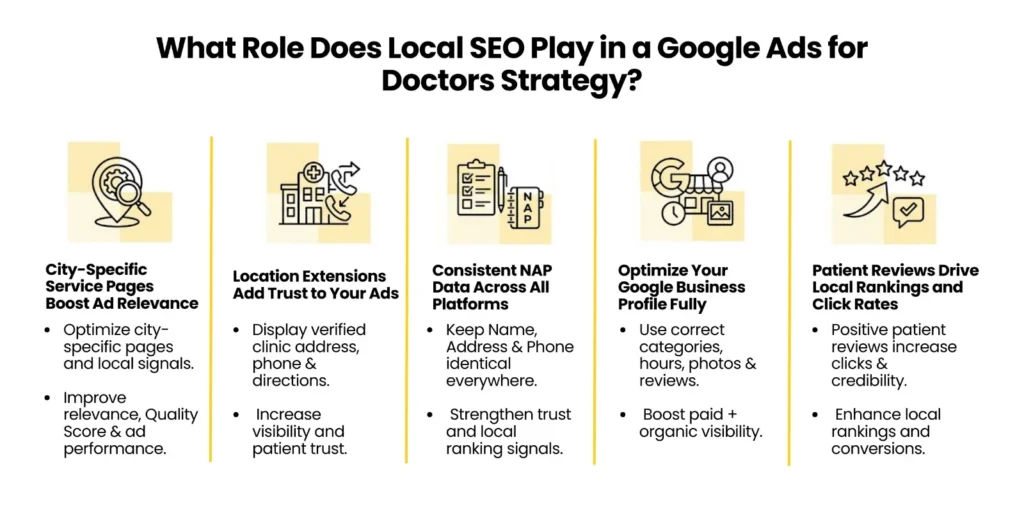
Local SEO and Google Ads for doctors are not parallel tracks — they actively reinforce each other. A strong local SEO foundation improves your ad Quality Score, lowers your CPC, and ensures that patients who find you — whether through paid or organic results — trust what they see.
1. City-Specific Service Pages Boost Ad Relevance
Optimized location pages (“Dermatology Clinic in [City]”) align your website content with the geographic targeting in your ad campaigns. Google rewards this relevance with a higher Quality Score meaning your ads rank better at a lower cost.
2. Location Extensions Add Trust to Your Ads
Linking your Google Business Profile to your ad campaigns enables location extensions displaying your verified address, phone number, and directions within the ad itself. Patients searching for a nearby doctor are significantly more likely to click when they can see the practice is genuinely local.
3. Consistent NAP Data Across All Platforms
Your Name, Address, and Phone number must be identical across your website, Google Business Profile, directory listings, and ad extensions. Inconsistencies confuse search engines and can suppress your local rankings — undermining both your SEO and paid ad performance simultaneously.
4. Optimize Your Google Business Profile Fully
A complete Google Business Profile — with accurate categories, updated hours, photos, and a steady stream of patient reviews — improves both map pack rankings and the performance of any ads linked to that profile. It’s one of the highest-leverage actions a medical practice can take.
5. Patient Reviews Drive Local Rankings and Click Rates
Positive reviews increase your visibility in local search results and directly influence whether patients choose your practice over a competitor — in both organic listings and below your paid ads. Actively requesting reviews from satisfied patients is non-negotiable in competitive healthcare markets.
"Doctors who optimize their local presence see higher ad Quality Scores, lower cost-per-click, and stronger organic rankings — all from the same work."
What Must Ad Copy Do to Support Your SEO Objectives?
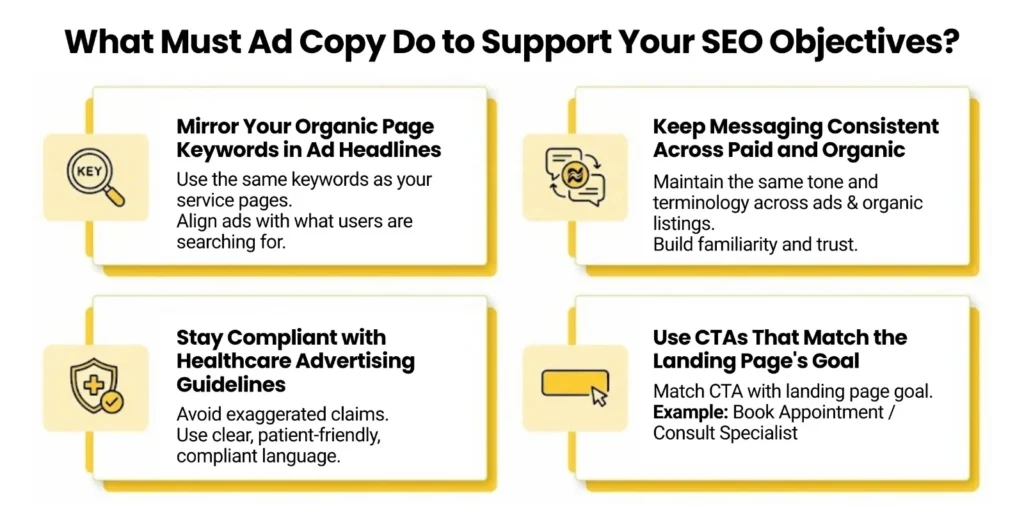
In a well-built Google Ads for Doctors SEO Outline, ad copy isn’t just a sales tool it’s a messaging consistency checkpoint. Every headline and description should mirror the language on your organic service pages, building familiarity and reinforcing your practice’s authority at every patient touchpoint.
1. Mirror Your Organic Page Keywords in Ad Headlines
If your SEO service page targets “knee replacement specialist in [city],” your ad headline should use the same phrase. This alignment satisfies the patient’s search intent, reduces bounce rates, and signals to Google that your ad and landing page are genuinely relevant.
2. Keep Messaging Consistent Across Paid and Organic
When patients see the same positioning and value proposition in your ad and then again in your organic listing, recognition builds quickly. Brand familiarity before a patient even visits your site increases the likelihood of a booking by a measurable margin.
3. Stay Compliant with Healthcare Advertising Guidelines
Healthcare ad copy cannot make exaggerated claims or promise specific outcomes. Frame copy around verified services, patient experience, and accessibility (“Board-certified specialist,” “Same-week appointments available”). Compliant ads also align cleanly with the factual, patient-friendly content required for strong healthcare SEO.
4. Use CTAs That Match the Landing Page's Goal
If the landing page’s primary action is booking an appointment, the CTA in your ad must be “Book an Appointment” — not “Learn More.” Mismatched CTAs create friction, reduce conversion rates, and send negative engagement signals that hurt both paid performance and organic ranking potential.
🎯Alignment = Efficiency
The KPIs That Actually Matter for Doctors Running Google Ads and SEO
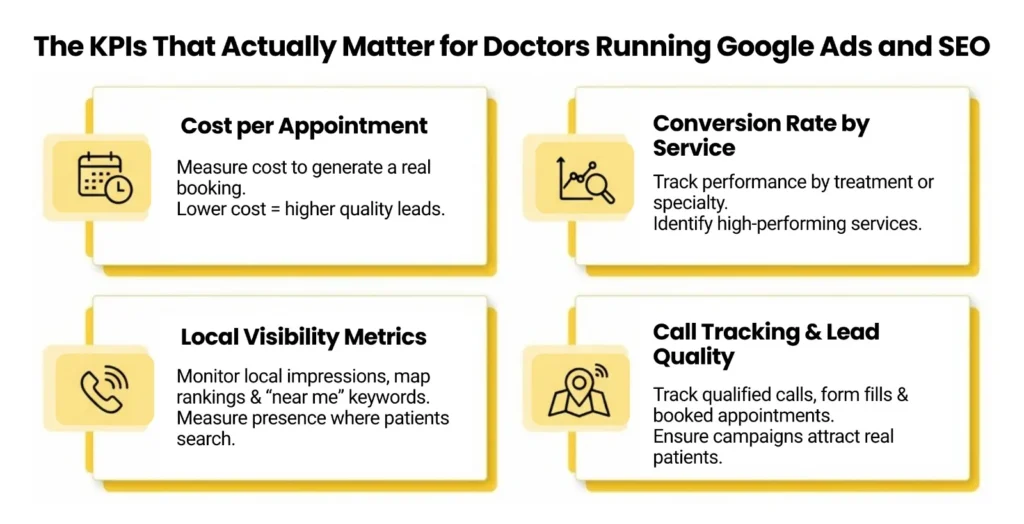
Traffic and impressions are vanity metrics for a medical practice. The KPIs that reflect real business growth and should guide every optimization decision in your Google Ads for Doctors SEO Outline, are all tied to patient acquisition quality, not raw volume.
💰 Cost Per Appointment
The most important metric. Track the actual dollar cost of generating a confirmed patient booking, not just a click or form fill. A declining cost per appointment means your combined strategy is working.
📊 Conversion Rate by Service
Different specialties convert at different rates. Monitor performance by service type to identify where to increase ad investment and where SEO content needs strengthening.
📍 Local Visibility Metrics
Map pack rankings, local impression share, and “near me” keyword performance. These directly reflect how discoverable your practice is at the moment patients are making healthcare decisions.
📞 Call Tracking & Lead Quality
Track which channels produce qualified calls, appointment requests, and bookings not just any calls. This separates genuine patient interest from low-intent inquiries and informs budget decisions.
📅 Review Cadence Recommendation
The Future: Google Ads + SEO in an AI-Powered Search World
AI-driven search from Google’s Search Generative Experience to tools like Perplexity and ChatGPT is fundamentally changing how patients find medical information. Doctors who adjust their Google Ads for Doctors SEO Outline now will be far ahead of practices that wait.
1. AI Favors Authoritative, Clinically Accurate Content
AI search engines are trained to surface neutral, expert-verified information not promotional language. For doctors, this means creating factual, patient-friendly content that reflects genuine clinical expertise. Avoid ad-style phrasing in your organic pages; authority content is what AI surfaces and cites.
2. Structure Content for AI Extraction and Citations
AI tools extract specific answers from well-organized pages. Use clear H2 and H3 headings, lead each section with a direct answer, and then elaborate. Pages structured this way appear in AI-generated summaries, knowledge panels, and “Featured Snippet” positions — all zero-cost visibility.
3. Semantic Content Structure Improves Both Organic and Ad Performance
Logical content organization clear sections, relevant subtopics, and internally linked service pages helps AI understand your site’s topical authority. This improves organic ranking in AI-influenced results and signals to Google Ads that your landing pages are high-quality, which improves Quality Score.
4. High-Quality Landing Pages Protect Ad Performance in AI Search
As AI reshapes organic search behavior, the patients who do click paid ads will have higher expectations for the page they land on. A structured, informative, fast-loading landing page becomes even more critical for maintaining conversion rates as AI filters out low-quality experiences.
🔮 What This Means for Your Strategy
FAQs
Can Google Ads data directly improve SEO performance for doctors?
Yes. Google Ads surfaces high-intent keywords, user behavior signals, and conversion data that directly inform which SEO pages to prioritize, which topics resonate with patients, and where organic content can have the fastest impact. It’s the most reliable shortcut to a smarter SEO strategy.
How does Quality Score in Google Ads relate to SEO work?
Quality Score is directly influenced by landing page experience, relevance, and expected click-through rate. When your SEO work produces a well-structured, fast, patient-focused landing page, Google Ads rewards that with a higher Quality Score — lowering your cost per click and improving your ad placement without increasing budget.
Should doctors run Google Ads and SEO on the same keywords?
Yes, strategically. Targeting the same high-intent keywords across both channels creates dual SERP presence, reinforces brand recognition, and reduces risk — if your organic ranking drops due to an algorithm update, your paid ad still captures that patient. Once your organic ranking is stable, you can reduce ad spend on that keyword and redirect it elsewhere.
How does AI-powered search affect medical keyword strategies?
AI search systems prioritize structured, factual, semantically rich content. For doctors, this means creating clear answers to specific patient questions — with proper heading hierarchy, direct answers at the top of each section, and medically accurate information throughout. Keyword stuffing is counterproductive; genuine expertise signals are what AI rewards.
How often should doctors review their combined Ads + SEO performance?
A monthly review cycle works well for most practices. Review cost per appointment, conversion rates by service, local map visibility, and call quality. Make keyword and budget adjustments based on seasonal demand patterns — for example, flu season, allergy season, and elective procedure planning periods all create predictable keyword spikes to capitalize on.