
When you’re running a small business, managing people can feel just as demanding as managing sales, operations, or customer needs. Tasks like payroll, hiring, compliance, and keeping employees engaged often take more time and effort than expected. This is where HR management solutions steps in and simplifies these processes and removes the burden of juggling spreadsheets or piles of paperwork. Instead of being bogged down by manual tasks, you gain reliable tools that make HR management easier, more accurate, and stress-free.
The best part is that modern HR management platforms are designed specifically with small businesses in mind. They come with flexible features, are affordable, and scale effortlessly as your company grows. In this guide, we’ve researched and compiled the 15 best HR management software for Small Businesses in 2025 to help you save time, ensure compliance, and support long-term business growth.
The Reason Why Small Businesses Require HR Management Software
It is common that small businesses have to wear many hats and have limited resources. This is a simplification that is offered through the help of HR management platform:
- Time Savings– Automating tasks such as payroll, leave approvals, and tracking attendance saves you between 5-10 hours every week. This enables business proprietors and managers to devote more time to strategy and growth as opposed to paperwork.
- Error Reduction – Manual processes often cause payroll, employee data, or compliance errors. HR management platforms reduce the possibility of error through standardization of workflows, and accuracy shall be present in all steps.
- Cost Efficiency – HR management tools are more cost-effective than hiring extra staff or outsourcing. This saves small businesses money, and yet it can still manage employees.
- Centralized Data Because information on employees, including personal and performance records, is held in a central location, it is stored safely. This simplifies accessibility, updating, and sharing of data without time wastage in search of files.
- Scalability – HR management tool adapt to a growing business, e.g., as it scales up to 5-50 employees. This makes the processes efficient and does not collapse even when the team is enlarged.
Through the implementation of HR management tools, small businesses streamline their operations, which also facilitates the establishment of a strong base upon which they can build in the long term.
List of HR Management Software for Small Businesses
1. BambooHR
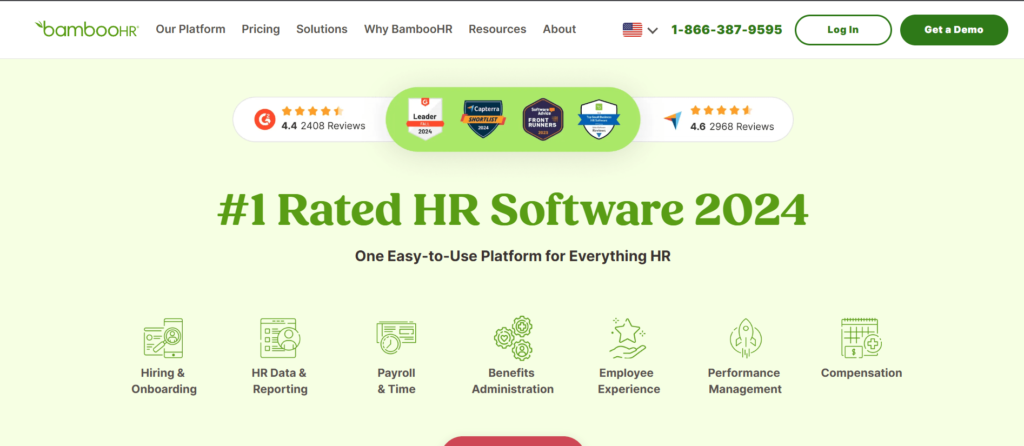
BambooHR is the most reliable HR management software in small and medium-sized companies. It organizes employee information, hence it is hard to lose track of records, employee performance, and objectives. With an intuitive dashboard, it makes the processes of hiring people, onboarding them, and developing them easier, and it makes small businesses stay organized, thus it does not require a large HR department.
BambooHR has powerful reporting capabilities that facilitate reporting-based workforce optimization. It also has good customer support and mobility accessibility, where HR activities are easy, even when on the move.
Along with HR features, BambooHR can also integrate with invoicing software, helping small businesses streamline payroll, expenses, and financial reporting in one workflow.
Key Features:
- Employee records management to keep all employee data organized
- Onboarding automation for smooth new hire integration
- Time off and leave tracking to monitor absences
- Self-service portal allowing employees to update information
- Reporting and analytics for HR insights
Best For: Small and mid-sized businesses
Price:
- Starts at $10/user/month (Core plan)
Pros:
- User-friendly, strong core HR features
Cons:
- Limited advanced features
2. Keka HR
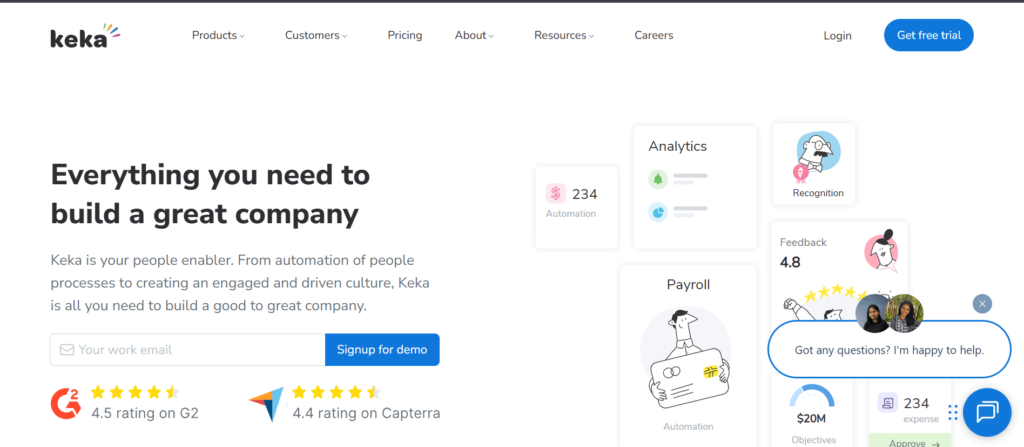
Keka HR is arguably the most reliable HR and payroll product in India, with the sole aim of serving organizations in the small and mid-sized business range. It makes processes such as payroll simpler and ensures compliance with the laws in India, such as PF, ESI, and TDS. In addition to payroll, it is easy to manage attendance, leave, performance, and how employees engage.
It has an intuitive interface and is automated, thus helping business owners save time while ensuring every process is secure, accurate, and compliant with current regulations. Indian startups and small and medium-sized enterprises (SMEs) are among the most enthusiastic users of Keka as the solution scales with increasing volumes of the company.
Key Features:
- Biometric and App-Integrated Attendance and Leave Management
- Accessibility of the employee self-service portal
- Follow-ups and administration of goals
- HR Insights analytics and reporting
Best For: Small and mid-sized businesses in India, particularly startups and SMEs
Price:
- Begins at about 6,999/month (up to 100 employees, depending on the plan and modules)
Pros:
- Good automation, scalable
Cons:
- Pricing may increase with scale
3. Zoho People
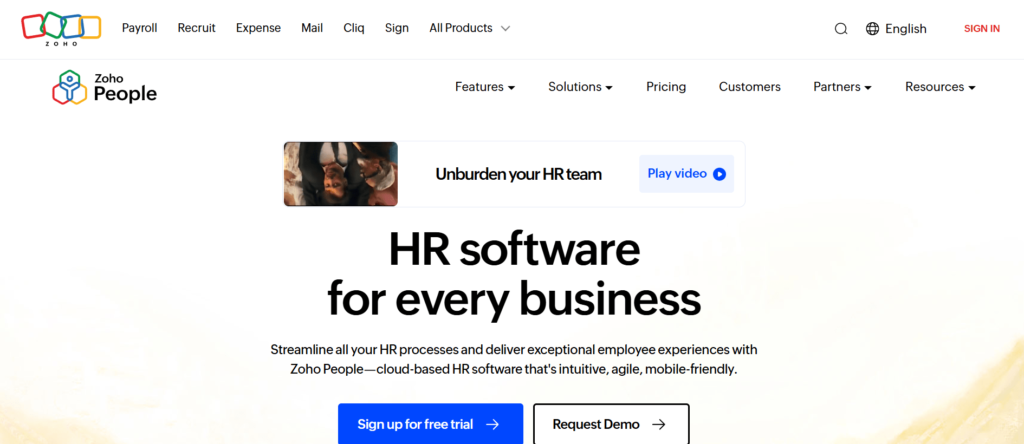
Zoho People is a cost-effective, feature-rich HR solution that is designed to fit into small businesses. It manages employees, attendance, and performance management, and has the advantage of being integrated with all other Zoho applications. Its flexibility is an advantage to startups because the system is easily scaled with an increase in teams.
It is mobile, and therefore, its usability enables HR activities to be administered when businesses are on the road or at any location. With workflows that are customizable, Zoho People easily fits into the requirements of small teams.
Key Features:
- Attendance and leave management for workforce monitoring
- Recruitment and applicant tracking for talent acquisition
- Performance appraisal system for employee evaluations
- Mobile access for HR tasks on the go
- Integration with the Zoho business apps ecosystem
Best For: Growing businesses
Price:
- Around ₹100/user/month
Pros:
- Affordable, integrated with Zoho apps
Cons:
- Limited customization
4. ADP Run
ADP Run is targeted towards small business owners in need of a high-quality payroll and HR system. It keeps the taxation, employee remuneration, and compliance smooth with minimal chances of making expensive mistakes. The reputation that ADP has enjoyed over a long time makes small businesses trust its activities.
Its mobile application and customer service provide additional convenience to it, making it a reliable one when it comes to daily HR needs. The system is also connected to the accounting system, making the accounting and HR processes more streamlined.
Key Features:
- Payroll processing and automated tax filing
- Employee self-service portal for information access
- Compliance and regulatory tracking to avoid penalties
- Automatic year-end tax forms for easy reporting
Best For: Small businesses focusing on payroll and compliance
Price:
- Starts at $79/month + $4 per employee
Pros:
- Reliable payroll and compliance
Cons:
- Pricing not transparent
Suggested Read: Small Business Ideas in Lucknow
5. Paycor
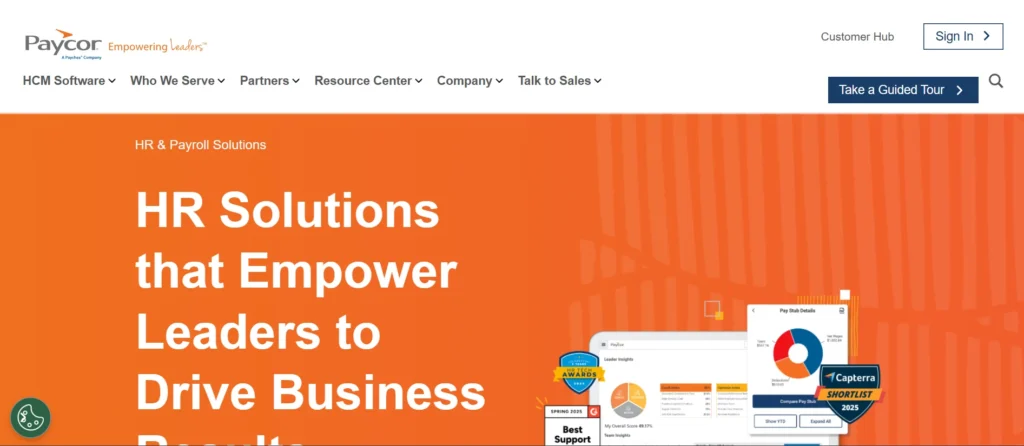
Paycor is a means of allowing small businesses to simplify the management of the workforce and provide data-driven insights. It also simplifies the recruiting, onboarding, payroll, and performance management on a single platform. One of the reasons business owners like Paycor is its scalability, so that the software can expand with teams.
Real-time analytics and reporting give leaders a smarter way to make HR decisions that enhance long-term employee retention, productivity, and data-driven HR decisions. It is also user-friendly, and teams of small size can easily use it and do not require high technical abilities.
Key Features:
- Payroll management with direct deposits and reporting
- Recruiting and onboarding tools for new hires
- Time-off tracking to manage leaves
- Compliance support to meet legal requirements
- Reporting and analytics for HR performance
Best For: Small to mid-sized businesses
Price:
- Custom pricing
Pros:
- Feature-rich, good scalability
Cons:
- Expensive for small businesses
6. Rippling
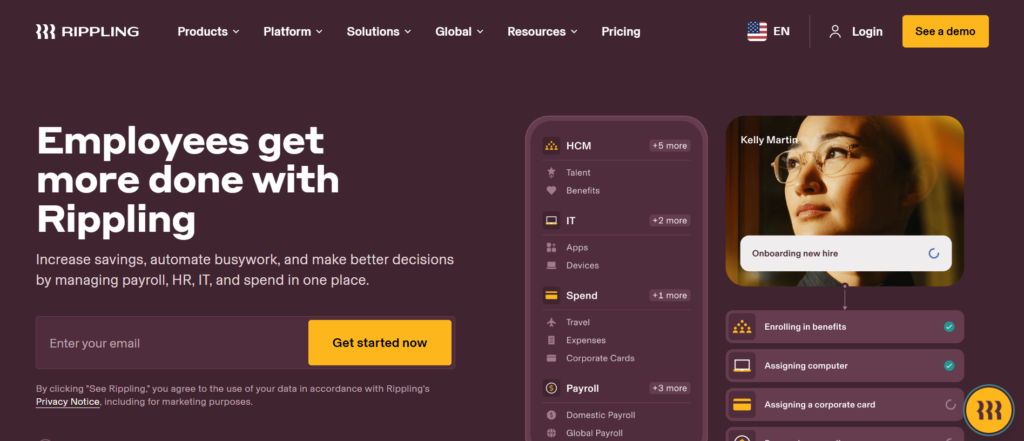
Rippling is not an HR system alone, but an HR, payroll, compliance, and IT management platform all in one place. It is especially useful when it comes to small companies that maintain a remote labor force because it assists in managing devices, applications, and staff member accounts.
Rippling is lowering the number of tools that are used separately and spending a lot of time and energy on them. It is also automating, thereby minimising manual work by the HR. The flexible nature of the platform renders it suitable for companies that prefer to run everything under the platform.
Key Features:
- Employee lifecycle management, including hiring to offboarding
- IT device and app provisioning automation
- Payroll and benefits integration
- Compliance management automation
- Workflow automation for HR and IT tasks
Best For: Tech companies and enterprises
Price:
- Starting around $30/user/month + base fees
Pros:
- Unified HR and IT management
Cons:
- Can be complex
7. Namely
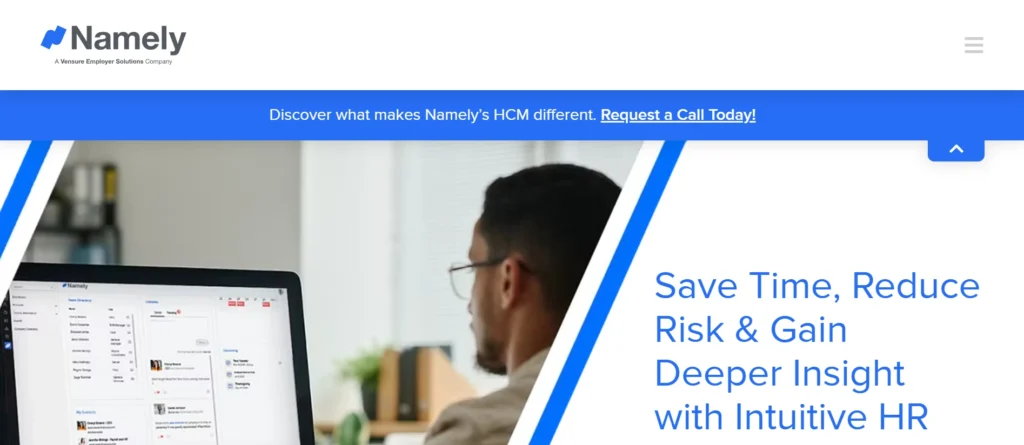
Namely is designed for small but growing businesses that are interested in providing a professional HR experience. Unifies the ability to manage the payroll, benefits, and performance in an integrated way. The tool promotes employee engagement, and it includes tools to promote collaboration and feedback.
Namely, with its culture-building-centered intuitiveness, it enables small businesses to keep healthy relationships between management and staff, as they grow. Its scalability will also not cause companies to grow beyond the capacity to meet their expanding workforce.
Key Features:
- Payroll and tax compliance services
- Benefits administration
- Employee onboarding automation
- Performance management modules
- Reporting tools for HR analytics
Best For: Mid-sized companies
Price:
- About $25/user/month
Pros:
- Customizable, comprehensive HR
Cons:
- Higher cost
8. Workday
Workday is also related to large businesses; at the same time, it can serve small businesses that still want fast expansion. It offers sophisticated HR, payroll, and finance applications in a scalable platform. Although powerful, it is very configurable and thus suitable for the more demanding small companies with advanced requirements.
Workday’s predictive analytics allows strategic planning by the leaders, where HR decisions are made to support long-term business objectives. Though it is an elite choice, it provides unrivaled insights and efficiency.
Key Features:
- Workforce planning and advanced analytics
- Global HR management capabilities
- Talent acquisition and development tools
- AI-powered workforce insights
- Payroll and finance system integration
Best For: Large enterprises
Price:
- Custom pricing
Pros:
- Powerful analytics and scalability
Cons:
- Very expensive, complex
9. Paychex Flex
Paychex Flex offers a combination of both flexibility of HR and payroll solutions that suits the small business. It also has a modular structure wherein companies can choose only those features that they need, ensuring affordable expenses. It promotes easy HR processes, such as employee benefits, acts of compliance, among others.
Another strength of Paychex is its excellent customer care services, together with training offers, which are of benefit to small units that lack an additional HR team. It is highly flexible, thus suitably applicable to companies at various levels of development.
Key Features:
- Payroll processing with flexible scheduling options
- HR administration tools for employee management
- Benefits management, including health and retirement plans
- Compliance assistance to meet regulatory requirements
- Reporting and analytics for business insights
Best For: Businesses of all sizes
Price:
- Custom pricing
Pros:
- Flexible plans, established provider
Cons:
- Cost can add up with add-ons
Suggested Read: How to Start an Ecommerce Business in Lucknow
10. TriNet
TriNet is an amalgamation of HR outsourcing and software, thus suitable for small companies that do not have an in-house HR professional. It facilitates payroll administration, compliance, and employee benefits and provides access to professional HR consultants.
This mixed model makes sure that businesses obtain technology and professional advice. TriNet is also an industry-specific provider and allows businesses to overcome industry-specific HR issues. It is suited to smaller groups who desire a particular experience without the need to hire new workers.
Key Features:
- Full-service payroll processing
- Benefits and risk management solutions
- Compliance support and risk mitigation
- Recruiting and onboarding services
Best For: SMBs needing full HR outsourcing
Price:
- Custom pricing
Pros:
- Comprehensive HR outsourcing
Cons:
- Expensive, complex contracts
11. Freshteam Freshworks
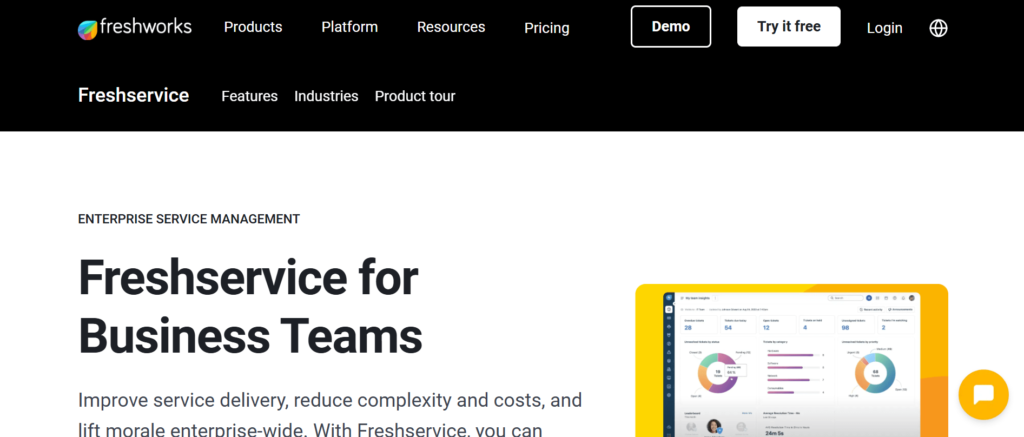
Freshteam is a low-weight but efficient HR management platform, concentrating on talent recruitment and staffing. It may be used by start-ups and small companies to make recruitment, onboarding and data storage efficient. The system can be established easily and is integrated with other products to increase the efficiency of Freshworks.
Applicant tracking system Freshteam is particularly appropriate when small companies are growing their team. It is inexpensive and can be afforded by start-up companies.
Key Features:
- Applicant tracking system for recruitment
- Employee onboarding workflows
- Leave and time off management
- Employee database management
- Time tracking tools
Best For: Startups and SMEs
Price:
- Free tier available
- Paid plans start around $50/month
Pros:
- Free tier available, easy to use
Cons:
- Limited advanced features
12. Deputy
Deputy is an employee management tool that focuses on workplaces with shift employees, such as restaurants, retail stores, and health care. It eases scheduling, time tracking, and communication in a convenient mobile environment. The employees are able to exchange shifts, take leave, log in and out with ease, and save management time.
In the case of a small business, Deputy will make the day-to-day operations run smoothly and will remove issues like scheduling conflicts, which may impede productivity. It further offers compliance tools to assist in the fulfillment of labor laws.
Key Features:
- Employee scheduling automation to create optimized staff work schedules easily
- Time and attendance tracking to monitor employee hours and attendance accurately
- Task management for assigning and tracking tasks within teams
- Team communication tools to facilitate seamless internal communication
Best For: Workforce management
Price:
- Starts at $2/user/month
Pros:
- Affordable, user-friendly
Cons:
- Basic HR functionality
13. Factorial HR
Factorial HR is a cheaper alternative to doing everything in one package in terms of managing the essential HR functions, such as requesting time-off, attendance, and the storage of documents. It saves the paper load and gives companies an orderly layout of employee records to follow. It is simple enough to be used by small groups within a very short period of time.
The customizable workflows also exist in Factorial, thus making the HR processes more compliant with the specifics of a particular company. The simple interface of the platform reduces the burden that HR presents to business owners.
Key Features:
- Manages employee leave and absence requests efficiently
- Tracks actual working hours for payroll and productivity analysis
- Integrates attendance and work hours with payroll systems
- Supports recruitment processes from job posting to hiring
Best For: SMEs and startups
Price:
- Custom pricing
Pros:
- Comprehensive features, modern interface
Cons:
- Pricing in euros may vary regionally
14. Cezanne HR
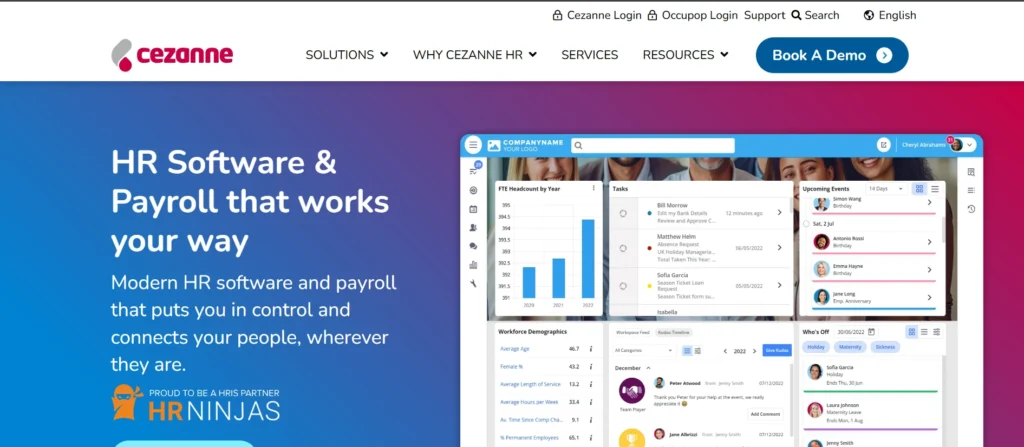
Cezanne HR offers a scalable HR solution that a small business can expand into. It includes performance reviews, onboarding, and compliance, and fits flawlessly with payroll options. It is user-friendly as it focuses on user experience, which is easy to navigate not only by managers but also by employees.
Cezanne HR has befitting automation capabilities, thus eliminating the excess manual work, while streamlining business administration toward strategic administration of HR needs rather than mundane administration. It is scalable such that it suits both small teams and growing teams.
Key Features:
- Centralized employee record management for easy data access
- Streamlines recruitment and onboarding processes
- Facilitates performance management, including reviews and goal tracking
- Tracks employee absences and leave balances
- Generates reports and analytics to support HR decisions
Best For: Growing companies
Price:
- Custom pricing
Pros:
- Good customization, detailed reporting
Cons:
- Custom pricing and complexity
15. Zimyo
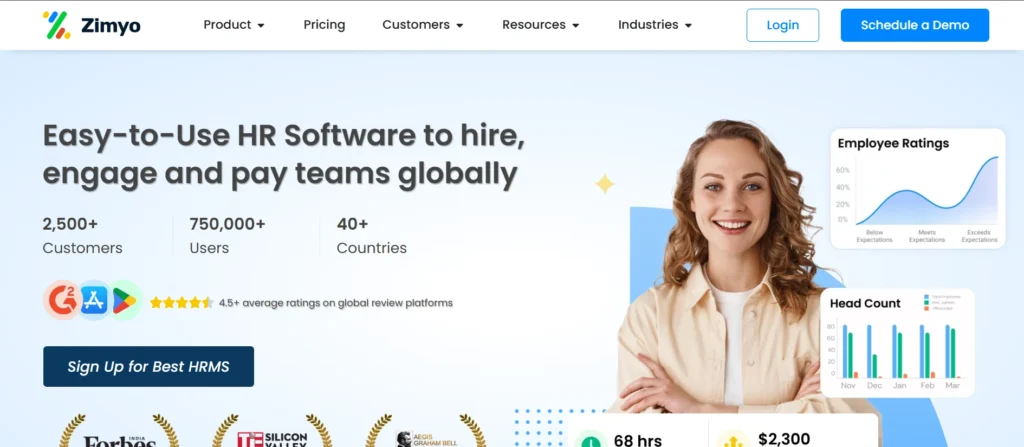
Zimyo is a contemporary HR tool and payroll software that has the Indian businesses in mind. It provides a comprehensive solution to the HRMS that includes payroll and compliance, employee engagement, and performance management, etc. It’s simple to navigate the dashboard can help small businesses streamline HR processes and be accurate in their statutory compliances, such as PF, ESI, PT, and TDS.
Having mobile access and employee self-service, Zimyo allows empowering HR teams and employees, making the workplace management efficient and transparent. It is an excellent match for businesses that are after a middle ground between cost-effective and feature-rich models.
Key Features:
- Main HR, leave, and attendance management
- OKR and performance management
- Mobile application and employee self-service portal
- Such tools of engagement as surveys and feedback
Best For: Mid-sized and small businesses
Price:
- Begins at approximately 80 per employee/month (plans differ by modules and employee count)
Pros:
- Strong payroll, easy compliance, ERP integrations, employee self-service
Cons:
- Add-ons cost extra, some features in higher plans, not ideal for tiny startups, can be complex for new users
Best HR management software Options: Features, Pricing & Benefits Compared
| HR Software | Pricing | Key Features | Best For |
| BambooHR | ~$10 per employee/month | Employee records, onboarding, time off tracking, performance management, reporting | Small to mid-sized businesses |
| Zoho People | ₹90 per employee/month (India) | Attendance, leave management, recruitment, performance management, and mobile access | Growing businesses |
| Keka HR | ₹6,999/month (up to 100 employees) | Payroll, HR automation, attendance, recruitment, performance management | SMEs |
| ADP Run | Custom pricing (quote-based) | Payroll, tax filing, compliance, employee self-service | Small businesses |
| Paycor | $99/month base + $6 per employee | Payroll, recruiting, onboarding, compliance, reporting | Small to mid-sized businesses |
| Rippling | $8 per employee/month | Payroll, benefits, IT management, compliance, workflow automation | Tech companies, enterprises |
| Zimyo | 80 per employee/month | Payroll, attendance, leave, performance, recruitment, analytics, mobile app | SMBs (50+ employees) needing automation & compliance |
| Namely | ~ $12 per employee/month | Payroll, onboarding, compliance, benefits, performance reviews | Mid-sized companies |
| Workday | Custom pricing (enterprise-grade) | Workforce planning, talent management, AI insights, payroll, and finance integration | Large enterprises |
| Paychex Flex | $39/month base + $5 per employee | Payroll, HR administration, benefits, compliance, reporting | Businesses of all sizes |
| TriNet | Custom pricing (PEO model) | Payroll, benefits, risk management, compliance, recruiting | SMBs needing HR outsourcing |
| Freshteam (Freshworks) | Free for 50 employees; paid from ₹4,999/month | Applicant tracking, onboarding, leave management, time tracking | Startups and SMEs |
| Deputy | $3.50 per employee/month | Scheduling, time tracking, task management, team communication | Workforce management |
| Factorial HR | €5.75 per employee/month | Leave management, time tracking, payroll integration, and recruitment | SMEs and startups |
| Cezanne HR | ~£4 per employee/month | Core HR, recruitment, performance management, absence tracking, reporting | Growing companies |
Tips on How to Select the Correct HR management software for Business
The first problem is having too many platforms to consider, and you feel overwhelmed. The trick is finding an appropriate fit of the software features, your business objective, the number of team members, and your budget. These are some of the key considerations:
- Determine Your Requirements – Figure out what HR functions you need help with the most, e.g., payroll, recruitment, or performance. What is it that will enable you to prioritize on software that addresses your pains directly.
- Ease of use– Small company operators and staff do not have to be trained to use the software technically. Select an easy-to-use interface platform with a clean interface that saves time.
- Scalability– Think with the long run. Ensure that the software will accommodate your standing staff numbers and give it the flexibility to incorporate new staff numbers in the future without having to incur major system changes in the future.
- Integration Options: Integration with what your HR management tool is present in the workplace. Like accounting software or project management apps, or communication platforms. This keeps the workflow smooth.
- Compliance Features– Find embedded compliance tools that allow meeting tax compliance, labor law, and data security regulations. This lessens risks and penalties.
Considering these factors thoroughly, small businesses will be able to invest in HR management software that will not only address their present expectations but will help them achieve future growth and success.
Conclusion
Payroll and attendance are only a small part of HR management—true success in a small business depends on streamlined processes, compliance, and employee satisfaction. Many owners lose countless hours on manual tasks that could easily be automated with the right tools. That’s why investing in HR management platform is not just a smart move, but a long-term growth strategy.
The 15 HR solutions we’ve highlighted in this guide make people management simpler, more accurate, and cost-effective. From recruitment and onboarding to payroll, benefits, and performance management, these platforms help small businesses stay organized and future-ready.
By choosing software that aligns with your team size, business goals, and budget, you’ll save valuable time, reduce stress, and build a more motivated workforce. In 2025 and beyond, the right HR management software can be the foundation for sustainable growth and long-term success.
FAQs
1. What is HR management software?
HR management software is a digital tool that helps small businesses manage employee data, payroll, recruitment, performance, and compliance. It saves time, reduces errors, and keeps all HR activities organized in one place.
2. Why should small businesses use HR management platforms?
HR management platform helps small businesses save time, ensure legal compliance, streamline employee data management, and improve overall employee satisfaction. It’s affordable, easy to use, and scalable as your business grows.
3. Are HR management platforms expensive for small businesses?
Not necessarily. Many HR management tools offer budget-friendly pricing plans suitable for startups and small teams. Some even provide free versions with limited features.
4. Which HR management tool is best for payroll management?
Solutions like ADP Run and Paychex Flex are highly recommended for payroll and benefits management, as they ensure accuracy and compliance.
5. Can HR management tools help with recruitment and onboarding?
Yes. Platforms such as BambooHR, Zoho People, and Freshteam include recruitment and onboarding tools to simplify hiring and help new employees settle in smoothly.