
Companies are competing for the attention of their customers on digital platforms, making lead generation increasingly competitive. Recent industry research reveals that 61% of marketers rank high-quality lead generation as their top marketing challenge, and businesses that adopt data-driven lead generation tactics can see up to 5-8 times more ROI compared to those who don’t.
In 2026, a rise in website visitors or random blogging is not enough to draw in qualified prospects. There are still businesses that spend time and money on activities that lead to more visibility, but not to actual leads.
It’s important to know what techniques are not going to work, besides what techniques are going to work. These basic and successful sales strategies can help boost conversion rates, lower customer acquisition costs, and give businesses a better stream of leads.
What is Lead Generation?
Lead generation is the practice of attracting visitors and getting them to show interest in your products and/or services. A lead is the person who has voluntarily provided you with their contact details, like their email address, phone number, or business information, because they want to know more about what you have to offer.
Leads can be created through diverse online and offline avenues, such as SEO, content marketing, paid advertising, social media, webinars, email marketing, and landing pages.
The main goal is to meet with people who are interested and build a relationship with them until they are ready to buy. A lead generation approach that targets only traffic, rather than focusing on qualified leads, can lead to low conversion rates and ultimately to the decline of the business.
Understanding the Difference — Activity vs. Outcome
Many businesses assume that staying busy with marketing automatically leads to better results, but that is no longer true. In 2026, successful lead generation depends on achieving measurable outcomes rather than simply completing more marketing activities. Posting on social media every day, publishing blog articles without keyword research, sending bulk email campaigns, or increasing website traffic means very little if those efforts fail to attract qualified leads.
The real goal is to generate prospects who are genuinely interested in your products or services and are more likely to convert into customers. To improve your lead generation strategy, every activity should have a clear purpose and be connected to a measurable KPI, such as lead conversions, form submissions, demo requests, or sales inquiries.
Instead of focusing on vanity metrics like impressions, likes, or page views, businesses should prioritize user intent, audience targeting, and conversion optimization. Understanding the difference between marketing activity and marketing outcome helps companies eliminate ineffective tactics, allocate their budget more wisely, and build a sustainable pipeline of high-quality leads. This mindset is essential for avoiding common lead generation mistakes and creating campaigns that deliver real business growth in 2026.
Which Activities Will Not Help With Lead Generation?
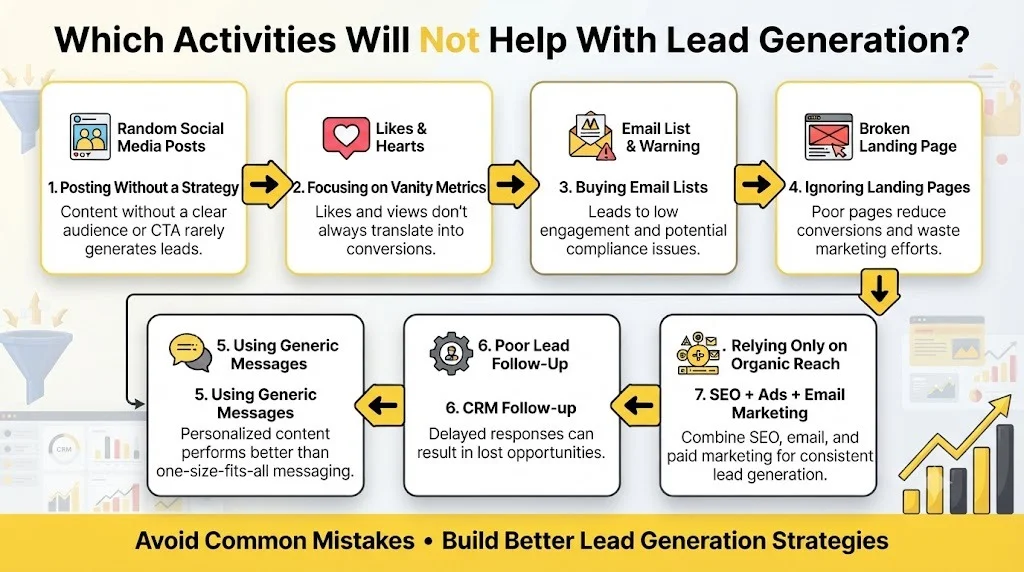
Many marketing campaigns result in visibility, but not in qualified leads. This awareness of ineffective activities enables companies to focus their efforts on activities that yield tangible outcomes.
- Posting Content Without a Strategy: When you don’t know what kind of audience you’re posting for on blogs or social media, it will not get you qualified leads. Content should solve customers’ problems, incorporate relevant keywords, and include specific next steps or calls to action.
- Dealing with vanity metrics only: Likes, comments, shares, and views can tell you how engaged your audience is, but not necessarily how many leads you’re generating. The true measure of success is not popularity; it’s conversions, inquiries, and qualified prospects.
- Buying Email Lists: There are lots of outdated or uninterested recipients in bought contact lists. This practice leads to poor engagement, deliverability, spam complaints, and potential compliance problems with privacy laws.
- Ignoring Landing Page Optimization: With a bad landing page, marketing dollars are lost. Lack of speed, confusing messages, and subpar CTAs drastically lower conversions.
- Create generic marketing messages: Broad marketing messages don’t resonate with specific audiences. One size does not fit all banners and messages. Crafting personalized messaging based on customer needs works much better.
- Neglecting Lead Follow-Up: Lead generation is just the initial step. Lack of timely responses or follow-up can lead to missed opportunities because customers opt for quicker competitors.
- Relying Only on Organic Reach: Organic social media reach is still on the decline. Without incorporating the ideas of SEO, email marketing, and paid campaigns, it can be difficult for a business to maintain a steady stream of leads.
Why Do These Activities Fail?
A lot of old marketing strategies don’t work because they focus on visibility rather than customer engagement. Today’s buyers demand more personalized experiences, more valuable information, and fast responses from the buyer’s journey.
1. Lack of Customer Intent
A major problem with lead generation campaigns is targeting the wrong audience. Many businesses target as many people as possible rather than people who are looking for their products or services. If marketing messages aren’t in sync with customer intent, website visitors are less likely to engage, submit inquiries, and turn into qualified leads.
2. Poor Data and Analytics
If you don’t monitor and track your marketing campaigns and efforts, you won’t know which ones attract high-quality leads. Metrics such as impressions, clicks, or visits to the website only give a partial view of the performance of a campaign. Tracking conversions, lead sources, and customer interactions helps you make informed marketing decisions and maximize return on investment.
3. Weak Customer Experience
End-user experience has a huge impact on lead conversion. Long loading times, confusing navigation, lengthy forms, unclear messaging, and lack of mobile-friendly layout drive visitors away and cause high bounce rates. Making your website easy to use, navigate, and generate a call to action will make your visitors stay longer and fill out your lead generation form.
4. No Lead Nurturing Process
Some visitors aren’t in a buying mood the first time they come to your site. If you don’t have any defined lead nurturing program, you lose great opportunities to cultivate relationships with prospective customers. Automated email campaigns, customized follow-up, educational content, and remarketing keep prospects engaged until they are ready to make a purchase.
Lead Generation Checklist
| Do’s | Don’ts |
| Create valuable, customer-focused content | Publish random content without a strategy |
| Optimize landing pages for conversions | Send visitors to generic homepage pages |
| Use clear and compelling CTAs | Assume traffic alone generates leads |
| Personalize marketing campaigns | Use generic messages for every audience |
| Track conversion metrics | Focus only on likes, followers, and impressions |
| Follow up with leads quickly | Delay responses to inquiries |
| Use SEO and high-intent keywords | Target irrelevant or overly broad keywords |
| Build email lists organically | Purchase email databases |
| Test and optimize campaigns regularly | Run campaigns without measuring results |
| Nurture leads through automation | Expect immediate sales from every visitor |
Effective Lead Generation Strategies
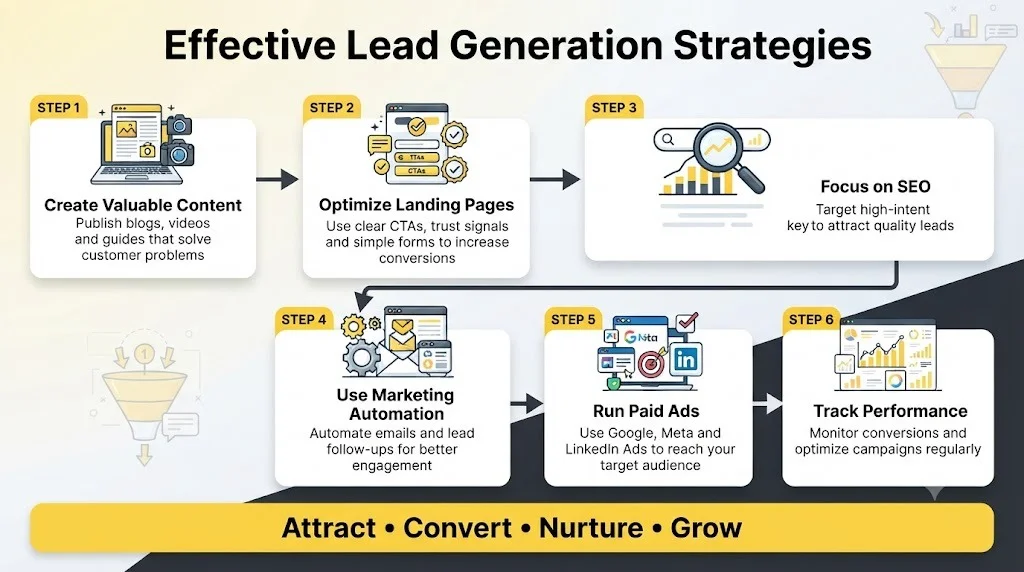
A successful lead generation strategy involves creating valuable content, providing a great user experience, and continually optimizing the process to attract and convert qualified leads.
1. Create High-Value Content
One of the best methods to generate quality leads is to produce high-value content. Create blogs, eBooks, case studies, videos, webinars, and downloadable materials that address customer questions and provide solutions to actual problems.
Informative content gains trust, boosts your SEO, makes you an industry authority, and prompts visitors to enter their contact details to access more useful information.
2. Optimize Landing Pages
An optimized landing page turns website visitors into potential customers. Be compelling; use short copy, clear benefits, trust signals, customer testimonials, and a strong call-to-action. Minimize distractions and keep forms short and easy to complete. Frequent A/B testing of headlines, layout, and buttons can lead to better conversion and better ROI from your marketing campaigns.
3. Invest in SEO and intent-based keywords.
SEO gives businesses the ability to reach users who are looking for a product or service that you offer. Target high-intent terms that suggest buying the product or service rather than informational terms.
Optimize website content, meta tags, internal links, and page speed for visibility. With improved search engine positions, quality traffic is often driven to the website and can easily convert to good business leads.
4. Use Marketing Automation
Marketing automation saves time and enhances lead nurturing. Send email campaigns, score leads, update CRM software, and follow up on user activity, all automatically. This means prospects are served relevant content at the appropriate time in the buying process. Automation can save time, boost efficiency, enhance customer connections, and improve the rate of lead conversion to repeat consumers.
5. Leverage Paid Advertising
Paid ads assist companies in connecting with their target audience fast. Ad platforms such as Google Ads, LinkedIn Ads, Meta Ads, and remarketing campaigns bring your business right to those who are looking for answers.
The use of highly targeted ads and optimized landing pages can bring better leads, higher conversions, less ad waste, and measurable results for sustainable business growth.
6. Monitor and enhance performance
Effective lead generation is an ongoing process that needs to be continually monitored and optimized. Monitor important figures like conversion rates, quality leads, customer acquisition costs, click-through rates, and return on investment. Regularly review performance data to look for opportunities for improvement.
Testing different strategies and refining campaigns based on insights helps businesses generate better-quality leads while maximizing overall marketing effectiveness and profitability.
Conclusion
Lead generation in 2026 is not all about driving traffic and being present online. A business needs to differentiate between what it does in marketing and what it actually accomplishes in the business.
Many of the outdated tactics are not only a waste of time and resources but also do not yield any quality leads, like buying email lists, depending on vanity metrics, failing to optimize landing pages, or publishing random content.
Businesses should focus on customer-centric content, data-driven decision-making, SEO, custom marketing, and ongoing lead nurturing. By eliminating ineffective activities and investing in proven strategies, businesses can build stronger relationships with prospects, improve conversion rates, reduce acquisition costs, and create a sustainable pipeline of high-quality leads.
FAQs
1. What Activities Do Not Help With Lead Generation?
Purchasing email lists, targeting only social media likes, posting random content, overlooking landing pages, and not following up on prospects are activities that generally yield few quality business leads.
2. Why Are Vanity Metrics Bad for Lead Generation?
Vanity metrics like likes, shares, or impressions are not about business growth. The better metrics of marketing success are qualified leads, conversion rates, and revenue.
3. What Are the Best Strategies for Generating Leads in 2026?
In order to capture and convert qualified leads, it is important that businesses invest in SEO, personalizing their content, optimizing their landing pages, implementing marketing automation, investing in paid advertising, and ensuring consistent lead nurturing.
4. Do Visitors to Your Sites Equate to Higher Leads?
Not all traffic leads to conversions, so don’t assume conversions will come in spurts with high traffic. To attract quality leads, it is vital to have the right traffic, great user experience, solid CTAs, and optimized landing pages.
5. Why Is Lead Nurturing Important?
Over time, lead nurturing fosters trust in your brand by providing personalized communication and relevant content to potential customers, promoting a higher likelihood of conversion.